So, I have lost my convention virginity.
Yesterday was the preview day for the London MCM Expo. As I live ten minutes walk away from the convention center (The ExCel Centre in East London), an appearance was always a given, especially as I had booked the afternoon (and the rest of the weekend) off work.
It was an interesting experience for the first-time convention-goer. I kept hopping from overjoyed to confused to (occasionally) intimidated by the scale of the event coupled with the sheer volume of content focused on areas which I have little to no knowledge. I was very surprised at the high manga and Japanese culture content of the convention. I know manga has been gaining popularity around the world, but I had no idea of the scale of this, or fanatacism of its fans and cosplayers. Yes, I know, my naivety in my expectations of the fans is readily apparent.
Being a comic fan, the first place I went to check out was the artist's alley. There were a lot of empty tables, but more than enough of the big names were present. I got the chance to say hello to Rich Johnson, formerly of Lying in the Gutters and now the founder and head of bleedingcool.com. As a semi-regular poster there (and, if all goes well, a front page article penned by myself has been submitted, and I'm looking forward to seeing what happens with that), this felt like an important meeting for me. But not as important as the next person I went to see - Tony Lee.
Tony is one of my favourite creators in comics. He is the current writer of the ongoing Doctor Who title(s) from IDW, which have been a great read. He topped the New York Times bestseller list with his graphic novel adaptation of Pride and Prejudice and Zombies. He was nominated for eight Eagle awards this year for his various projects, and his twitter feed - @mrtonylee - is one of the most interesting ones I read. As I was the first person to approach and buy from him, he cut me a great deal on the latest issues of the Doctor Who comic, and between sucking on his absinthe lolly, he pointed out that one of his Doctor Who co-creators - Al Davison - was present.
I didn't know Al Davison as anyone other than an occasional Doctor Who artist, although his career has been long and varied. His graphic novel autobiography - a work in progress - is a beautiful piece of work, chronicling a difficult and tragic childhood. Check it out at Muscle Memory, but be warned, it's not an easy read.
Finally, I was pulled over by Claude Trollope-Curson of Gronk Comics, who showed me some of his weird and wonderful creations. He did the best thing of making me laugh at his work in seconds, and I was happy to buy a couple of his publications. We ended up reading them on the Underground at 10.30pm on our way to a free showing of Due Date, and even my non-comic-reading girlfriend found his parodies of super-hero culture amusing.
I did some other stuff as well, including trying Magic: The Gathering for the first time in about a decade, and marvelling at all the cosplayers. One guy was dressed as Where's Wally (Where's Waldo for the Americans out there), and he cut a sad and lonely figure winding his way through the long, empty queueing system. I thought that he might have been playing the longer game, and that if the massive queue system was full then he would have been in his element. As the queue started moving as people were let in, I passed him once, then prepared to pass him again. But he had gone. Where was Wally? Suddenly, I understood the genius of his costume choice, and I berated myself for ever doubting him.
I'm really looking forward to today. I'm excited about meeting the Kieron Gillen, who recently wrote an amazing four-issue post-Siege fill-in run on Thor, and who just won an Eagle award for his series Phonogram. I'm hoping to meet Criminal artist Sean Phillips, and I'll be stopping by Bernard Chang's table to pick up the latest issue of Supergirl and hopefully get the panel with Arsenal and his quiver of dead cats signed. But most importantly, I'm really looking forward to meeting Chris Claremont, and Paul Cornell, who will be signing my first ever Doctor Who book, Timewyrm: Revelation, as my love of Who trumps my love of his current Action Comics run.
Right, enough buggering about. The con is open and I need to put trousers on and go there. Follow me on twitter at @quizlacey to keep up with me throughout the day.

As I start to head into my late 20s, I realise that I'm only three years younger than the Man of Steel Superman. Join me as I chronicle and review his life.
Saturday, 30 October 2010

Wednesday, 27 October 2010
A brief update
Shock! Horror! This is not an imaginary post!
So, I've not been around for a couple of weeks. I've been feeling a lot of stress and pressure at work, which has made my non-work life, such as it is, feel very awkward. I've not been getting pleasure from the things that normally help me relax and unwind, and I've spent the last couple of weeks in a state of near perma-tension. All of which has made sitting down to read comics, analyse them, and write about them on this blog a task that has felt like an unnecessary chore, rather than a welcome pleasure.
The good news is that things have quietened down , and I can feel my life returning to normal. I've got a long weekend off ahead of me that I intend to spend geeking out in the most fantastic way. I'll be attending my first ever comics convention, the London MCMExpo, which takes place in a building about 10 minutes walk away from my front door. I'm looking forward to meeting the cream of British comic creators, including the wonderful Mr Tony Lee, Kieron Gillen, current Action Comics writer Paul Cornell, and the legendary Chris Claremont. I'm hoping to get in on the Paul exclusive footage (I'm a big Simon Pegg fan), attend the Eagles awards, and hunt down Lying In The Gutters and bleedingcool.com writer Rich Johnston.
In short, I'm looking to have a great weekend re-connecting with my inner (and outer) geek. And when it's all over, I'm gonna open up my longboxes, pull out my copy of Booster Gold #7 and get some thoughts posted here.
Next on World of Superman: Comics'n'stuff. Honest.
So, I've not been around for a couple of weeks. I've been feeling a lot of stress and pressure at work, which has made my non-work life, such as it is, feel very awkward. I've not been getting pleasure from the things that normally help me relax and unwind, and I've spent the last couple of weeks in a state of near perma-tension. All of which has made sitting down to read comics, analyse them, and write about them on this blog a task that has felt like an unnecessary chore, rather than a welcome pleasure.
The good news is that things have quietened down , and I can feel my life returning to normal. I've got a long weekend off ahead of me that I intend to spend geeking out in the most fantastic way. I'll be attending my first ever comics convention, the London MCMExpo, which takes place in a building about 10 minutes walk away from my front door. I'm looking forward to meeting the cream of British comic creators, including the wonderful Mr Tony Lee, Kieron Gillen, current Action Comics writer Paul Cornell, and the legendary Chris Claremont. I'm hoping to get in on the Paul exclusive footage (I'm a big Simon Pegg fan), attend the Eagles awards, and hunt down Lying In The Gutters and bleedingcool.com writer Rich Johnston.
In short, I'm looking to have a great weekend re-connecting with my inner (and outer) geek. And when it's all over, I'm gonna open up my longboxes, pull out my copy of Booster Gold #7 and get some thoughts posted here.
Next on World of Superman: Comics'n'stuff. Honest.
Sunday, 17 October 2010
I'm Proud Of The BBC
No posts for a few more days, as I'm pretty horribly ill and can't really focus on much at the moment. But to tide you over, a ratehr wonderful song and video from a comedian I've been following for years. I'm proud of the BBC, and here are a few reasons why...
See you in a few days!
See you in a few days!
Thursday, 7 October 2010
Booster Gold #6
This blog post has had a pretty tortured history. I had a chunk of it written, and then blogger had a fit and deleted a bunch of it. I then tried to get it written again, but blogger wouldn't let me edit or create new posts. After quite some time, I discovered that my browser was at fault, having crashed whilst attempting to update. This happened whilst I was away from my desk, so I had no idea about the update, until tonight when a little popup informed me. So, we're back, but a little behind schedule.
One of the things I got the chance to do whilst not blogging was to take a look at the latest episode of Smallville. As normal, there were things I liked and things I disliked, and as normal, the big money-shot moments just seemed to come across as a bit flat. I really dislike this new version of Cat Grant. The super-bubbly-perky character, the relentless parroting of 'Godfrey' (if she's such a hotshot young reporter, shouldn't she have her own opinions?), the forced pairing with Clark. I would be happier if they wrote the character as a normal person with the views that she has, and let the performance lead the irritating side of the character. I also found the 'lifestyle' comments regarding vigilantes to be incredibly heavy-handed. It's been covered elsewhere in more detail, but I also need to point out that Deadshot and Jonah Hex are two different characters, and nothing is gained by combining the two. And the revelation of the new costume for Clark was spoiled by some really bad CGI, especially on the flags waving limply in the background.
 What I absolutely loved about the episode was the Carter Hall/Lois Lane subplot. Michael Shanks was great in Absolute Justice, but playing the identity rather than the hero really gave him the chance to shine. I loved his annoyance at Lois in the first scene, but what really sold me was the closing scene where he wonderfully conveyed centuries of love and loss. Erica Durance as Lois Lane has come on by leaps and bounds since I last really saw her in the role, back when she was first introduced. For probably the first time since the early days of Lois and Clark (or The New Adventures of Superman, if you're British), I was watching the Lois Lane that I have read for years in the comics. I wasn't expecting to be this impressed by her, but she is something I will enjoy watching in future episodes.
I also read the recent JLA/JSA crossover, but if you want to know about that, check out this episode of The LanternCast. The poor guys did the episode once, then lost the episode before it could be released, so they had to do it all over again. And the only way one of them could cope was... well... let's just say he wouldn't have been driving that day!*

 To Cross The Rubicon
Creator/Writer/Artist: Dan Jurgens
Inker: Mike DeCarlo
Letterer: Augustin Más
Colorist: Nansi Hoolihan
Editor: Al Gold
Cover Art: Dan Jurgens and Mike DeCarlo
Cover Date: July 1986
Release Date: 14/04/1986
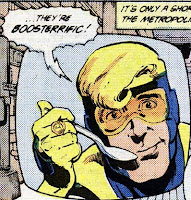


 This is a great Superman issue, and fits neatly into the timeline between The Man Of Steel #5 and #6. Superman here is confident in his position in the world, having already met and worked with one wave of heroes. Now, with the appearance of Booster Gold several years into his own career, Superman is starting to encounter the next wave of heroes, people whose motivations lie in places other than benevolence. His outrage at Booster's self-centered money-making activities, all of which stem from theft, is entirely justified, and comes from a place of confidence in not only himself but his position in relation to other heroes. The first panel in which Superman appears, a one-page splash where he stands above Booster, looking down with an expression of derision, neatly sets up how he feels, and completely wrong-foots Booster, for who Superman is a personal hero.
One of the things I got the chance to do whilst not blogging was to take a look at the latest episode of Smallville. As normal, there were things I liked and things I disliked, and as normal, the big money-shot moments just seemed to come across as a bit flat. I really dislike this new version of Cat Grant. The super-bubbly-perky character, the relentless parroting of 'Godfrey' (if she's such a hotshot young reporter, shouldn't she have her own opinions?), the forced pairing with Clark. I would be happier if they wrote the character as a normal person with the views that she has, and let the performance lead the irritating side of the character. I also found the 'lifestyle' comments regarding vigilantes to be incredibly heavy-handed. It's been covered elsewhere in more detail, but I also need to point out that Deadshot and Jonah Hex are two different characters, and nothing is gained by combining the two. And the revelation of the new costume for Clark was spoiled by some really bad CGI, especially on the flags waving limply in the background.
 What I absolutely loved about the episode was the Carter Hall/Lois Lane subplot. Michael Shanks was great in Absolute Justice, but playing the identity rather than the hero really gave him the chance to shine. I loved his annoyance at Lois in the first scene, but what really sold me was the closing scene where he wonderfully conveyed centuries of love and loss. Erica Durance as Lois Lane has come on by leaps and bounds since I last really saw her in the role, back when she was first introduced. For probably the first time since the early days of Lois and Clark (or The New Adventures of Superman, if you're British), I was watching the Lois Lane that I have read for years in the comics. I wasn't expecting to be this impressed by her, but she is something I will enjoy watching in future episodes.
I also read the recent JLA/JSA crossover, but if you want to know about that, check out this episode of The LanternCast. The poor guys did the episode once, then lost the episode before it could be released, so they had to do it all over again. And the only way one of them could cope was... well... let's just say he wouldn't have been driving that day!*

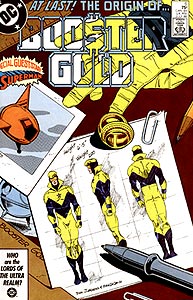 To Cross The Rubicon
Creator/Writer/Artist: Dan Jurgens
Inker: Mike DeCarlo
Letterer: Augustin Más
Colorist: Nansi Hoolihan
Editor: Al Gold
Cover Art: Dan Jurgens and Mike DeCarlo
Cover Date: July 1986
Release Date: 14/04/1986

Jason Redfern (Fern), a teenage boy, discovers a miniature spaceship in Centennial Park, long with a miniature alien. The alien’s language cannot be understood, so Fern calls him ‘Zee’. When Zee pushes him out of the way of the exploding space-ship, Fern is convinced of his good intentions, and takes him home. At home, Zee projects an image of Superman’s ‘S’ shield, which Fern interprets as Zee’s desire to locate Superman. Catching an advert featuring Booster Gold on the television, Fern realises how to get hold of Superman. He travels to Reilleau Towers, where he is able to see Booster and tell him his story. Booster then publicly calls Superman out through the media to meet him the next day.
The next day, the media is buzzing with Booster’s decree. Clark Kent hears about it at the Daily Planet, and sneaks away to become Superman. Booster Gold arrives at the rendezvous point, having stopped off at STAR Labs to grab a life-support suit for Fern. Although Skeets is sceptical about whether Superman will show, the Man of Steel arrives. Superman is disdainful of Booster, his publicity seeking ways, and the fact that his powers are artificial. Disappointed in the reactions of his hero, Booster walks away. Skeets speaks to Superman, and reveals the secret origin of Booster Gold.

Michael Carter was a prodigious football player, the biggest name in college football in the 25th century. As he was on the verge of being signed up professionally, he was caught betting on his own games, and expelled from college. With no further hope as an athlete, and needing to make a living, he took a security job at the space museum, as well as enrolling as a student of 20th century super-heroes. Whilst participating in the studies and his duties at the museum, Michael formulated a plan, cemented when he discovered Rip Hunter's time machine in the museum. Disabling the security robot Skeets, Michael steals various exhibits to create a power suit, then travels back to the twentieth century in the time machine, taking Skeets along with him.
Superman is shocked to hear this, and accuses Booster of theft, and using the stolen equipment to make himself rich. As the two argue, Zee starts speaking. Superman recognises snatches of the language, and is able to discover that a warship is chasing Zee. Suddenly, an energy burst renders Superman, Booster and Fern unconscious. Another miniature alien appears, abducting the heroes, Fern, Zee and Skeets onto his ship, which departs for space.

pre-dates The Man Of Steel #1 by three months, meaning that we have here the very first appearance of the post-Crisis Superman. Booster does it again! This also means that Dan Jurgens debuted his art for Superman before John Byrne, and it's great art. His first panel, featuring Clark changing to Superman in an interpretation of an iconic pose, is wonderful to look at, and as fans of this era know, Jurgens' Superman art is a real keystone of the next fifteen or so years of the character.
 This is a great Superman issue, and fits neatly into the timeline between The Man Of Steel #5 and #6. Superman here is confident in his position in the world, having already met and worked with one wave of heroes. Now, with the appearance of Booster Gold several years into his own career, Superman is starting to encounter the next wave of heroes, people whose motivations lie in places other than benevolence. His outrage at Booster's self-centered money-making activities, all of which stem from theft, is entirely justified, and comes from a place of confidence in not only himself but his position in relation to other heroes. The first panel in which Superman appears, a one-page splash where he stands above Booster, looking down with an expression of derision, neatly sets up how he feels, and completely wrong-foots Booster, for who Superman is a personal hero.
Of the two parts of this story, I feel that this is the stronger of the two. We get the first revelation of Booster's origin, devoid of the later embellishments and cliches that Booster would add, and the force of Superman's anger towards Booster has a powerful effect on the reader.
The Geeky Bits: Booster Gold is pretty much the first post-Crisis superhero, despite his first issue being released before the Crisis had finished publication. He has been a mainstay of the DCU, thanks to his high-profile membership of various incarnations of the Justice Leagues from the JLI onwards. He was also the first solo creation of Dan Jurgens for DC, but as before, I'm going to hold off on a full bio of Dan for a bit longer.
The title refers to the Rubicon river, which was crossed by Julius Caesar in 49BC, initiating a civil war. In general, the phrase 'To cross the Rubicon' refers to the point of no return, in this case the moment where Booster travelled in time to the twentieth century.
Next on World of Superman Booster Gold: The second half of this tale where Booster smacks down with Superman. Unless you've seen the cover, in which case you'll see that it's more a case of Superman smacking Booster down. Ouch.
*worldofsuperman.blogspot.com does not condone excessive alcohol consumption for the production of podcasts, blog posts, tweets, or any other type of new media (unless it's Lit Beer: My beer).
Monday, 4 October 2010
The Man Of Steel #5

Happy birthday to you,
Happy birthday to you,
Happy birthday dear worldofsuperman.blogspot.com,
Happy birthday to you.
Yes, believe it or not, it's been a year since the World of Superman snuck onto the blogging scene. In that time, we've covered the death of Krypton, affairs with Lex, the birth of the
So, we're back with The Man of Steel, and we're going to finish it in the next few posts before moving onto the regular series. Well, apart from a couple of diversions. But it wouldn't be the World of Superman if we didn't detour along the way...
 The Mirror, Crack'd...
 Script and Pencils: John Byrne
Inking: Dick Giordano
Lettering: John Costanza
Coloring: Tom Ziuko
Editing: Andrew Helfer
With special acknowledgement to the work of Otto Binder
Cover Artist: John Byrne
Cover Date: December 1986
Release Date: 11/09/1986
Superman returns a LexCorp-built battle armour suit to Lex's penthouse. Luthor claims that the suit was registered as stolen, and that the pilot was fired from LexCorp weeks ago. Sadly, the pilot cannot corroborate Lex's story as prolonged exposure to the suit has left him brain-dead. As Superman flies away, Lex heads into his laboratory and talks to Doctor Teng, who tells him that his scans have revealed that Superman is not a mutated human, but an alien. Lex asks how this will affect the duplication process, and Teng replies that they will see. A chamber opens, and an exact replica of Superman steps out. After a few seconds, the replica collapses, its body crystallising. Luthor is disappointed and orders that the duplicate be destroyed.
 In Metropolis, Lois Lane prepares to leave for work. She argues with her sister Lucy, who is bitter about her blindness. Outside, an ambulance gets stuck in traffic. Suddenly, it is lifted above the streets and dropped off at the hospital. The EMTs prepare to thank Superman, but are shocked to see that a monster has saved them. As 'Superman' flies away, he saves the life of Lucy Lane, who has thrown herself off of Lois' balcony. 'Superman' flies away, as Lucy wonders why he was so dusty.
At the Daily Planet, a disturbance in the lobby causes Clark to run out of the newsroom. He confronts the source of the disturbance, the distorted Superman who has partially disguised himself as Clark Kent. 'Clark Kent' wallops Superman, sending him flying out of the Daily Planet building. As the two fight, 'Superman' uses his heat vision on Superman, causing him intense pain. As they fight, Superman notices Lois watching, and uses his heat vision to destroy 'Clark Kent's clothing to protect his identity.
 'Superman' grabs Lois Lane and flies away with her. In the air, he gives her a kiss, before taking her to her sister. As Superman arrives, Lucy explains that since 'Superman' saved her, she has been able to see shapes and shadows. The two Superman fight some more. Superman analyses the dust that falls off 'Superman', and discovers that his foe is not an organic creature. Deciding that he is not truly alive, Superman charges him with all of his might. The impact causes 'Superman' to explode, showering the neighbourhood with dust. Exposure to the dust restores Lucy's sight. Superman wonders if 'Superman' knew of the healing powers of his dust when he died.
For an issue of one of the most notable Superman mini-series ever published, there doesn't seem to be a whole lot to say about it. Of all the issues, this is the most 'business-as-usual', with its notable first occurrences being rather understated.
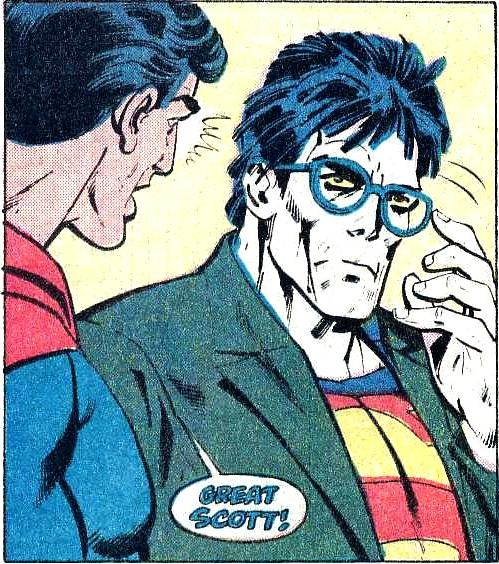
I think the problem with this issue is how little has carried over into the continuity of the comics. Lucy Lane has her blindness cured and stops being suicidal in this issue, and her blind period is rarely referred to again. Of course, in terms of things about Lucy Lane that are never mentioned again, her blindness comes in a distant third to her marriage to Ron Troupe and her child. We also have the revelation to Lex Luthor that Superman is not human in any way, that he is an alien. Having Luthor in a position where he knows more about Superman's origins than Superman does is potentially an interesting status quo, but this doesn't last beyond the next issue.
Superman faces a being whose powers match his own for the first time here. Although he has fought aliens and encountered New Gods, this is the first time that he feels his own powers being used against him. He is concerned for his well-being, and feels pain, possibly for the first time, when 'Superman' unleashes his heat-vision on him. However, this encounter is soon forgotten. When Metallo attacks in Superman #1, he wonders when the last time he was hit so hard was.
Perhaps the biggest event in the issue which fails to carry over into the ongoing series that followed The Man of Steel is the bogus 'Superman', or as fans know him better, Bizarro. He is never named in this issue, and it's another eight years until the character returns. The character is also played down in a more muted fashion. Most of the bizarre elements associated with the character, from the reverse-speak to the literal Bizarro-world, are missing. Instead, this version of Bizarro is very much a Frankenstein's monster, misunderstood and unable to comprehend the results of its actions, except possibly in one moment of realisation and sacrifice. However, the encounter doesn't seem to phase Superman at all. Having deduced that 'Superman' is an artificial being, Superman shows no signs of following up his appearance. He seems to accept that such warped doppelgangers exist, and that having got rid of one, he has faith that there will be no more.
 There is an interesting moral dilemma for Superman that occurs during his fight with 'Superman'. Realising that only one of them will walk away from the fight, Superman examines the dust that 'Superman' sheds wherever he goes and theorises that he is an artificial being, and thus, not being alive, can be killed. Once Superman has made this distinction, he is able to use levels of force that he would otherwise be unable to use against a living being, no matter how dangerous that being may be. In short, Superman is able to terminate 'Superman' for the greater good without any of the guilt that would follow the next time he decided to kill.
These issues aside, there are some strong moments in the issue. We get a good look at how Lois and Clark function in the Daily Planet newsroom, and we also get the first instance of Clark abandoning the newsroom to address a problem as Superman. Lucy's suicidal tendencies, whilst melodramatic, are a hint to a darker type of storytelling to that normally associated with Superman. The same goes for the implication that Luthor deliberately caused one of his henchmen to suffer brain damage in one of his schemes to better Superman. And whilst Superman's fears for his mortality in his fight with 'Superman' aren't as pronounced as the ones he felt whilst stranded in space in Action Comics Annual #7, the art and writing effectively communicates the feeling that Superman is out of his comfort zone.
The Geeky Bits: The Special Thanks credit for Otto Binder refers to the fact that this issue's plot owes a lot to the original appearance of Bizarro in Superboy #68 from October 1958. There, as here, Bizarro is very much cast in the Frankenstein's Monster role, and the subplot involving a blind girl is shared between the two stories. The more familiar version of Bizarro wouldn't appear until Action Comics #254 in July 1959.
This is the first of three post-Crisis version of Bizarro. 1994 saw the publication of the Bizarro's World story, in which Lex Luthor II recreates the duplication experiment, but with similar failure. The current version of Bizarro debuted in the Emperor Joker storyline from 2000, where he was a creation of The Joker, who had been infused with Mr Mxyzptlk's powers, and this incarnation has regularly appeared in the Superman books since then.
Next on World of Superman: A mere six months after reviewing The Man of Steel #1, we
Sunday, 26 September 2010
JLA Classified #49
I really dislike leaving a full week between posts, but unfortunately, every now and again, work rears its ugly head and monopolizes my life to the point where I barely have the energy to to anything other than eat between walking through the door and going to bed. I did, however, find the time to squeeze in the season premiere of Smallville last night, and despite missing out on the best part of five years' worth of plot, I was not surprised to see that a lot of what drove me away from the series is still there.
 We had moments of insanely bad acting (especially the scene where Clark returns to the Watchtower, and Tom Welling cannot find a sensible way to deliver the line 'But I'm here now. what about the others, did they make it?'), comedy that wasn't funny or made any sense (I had no understanding of the 'dropping the pen' scene), and, of course, at least one moment where the ambition of the show went far beyond its ability to deliver. The moment where The Blur (euch) raises the Daily Planet globe appears to have been witnessed by about 12 people, which isn't bad for a major metropolitan city.
I was watching for the money-shot. I had heard that Darkseid was to appear in the episode, and as he is one of my favourite villains of all time, I was eager to see how he would be handled in live-action. Well, as it turns out, he was being presented as a non-sequitorial puff of smoke that bore a fleeting resemblance to the villain we know and love. Remember how for about half a second you could see the outline of the true Galactus in Fantastic Four 2: Rise of the Silver Surfer? That's how it felt to me.
It wasn't all bad. The John Schneider scene looked for a moment like it was going to a terrible waste of potential, but turned into something quite beautiful and moving. The shadow of Michael Rosenbaum enhanced the episode rather than making him noticeable by his absence (although the fake clone Lex needed far fewer cliches to go along with the effectiveness of his corrupted Lex visual). And the introduction of the Superman, suit, something I wasn't expecting, was very nicely handled, and I like the way that the final shot set the concept of Superman as a prize for Clark at the end of the season, as well as a reward to viewers for ten years of support.
I think I'll do my best to keep up for this series. I'm going to be interested in how Apokolips is handled in live-action, and the return of the Justice Society is going to be more than enough to keep my inner geek satisfied.
**WARNING!**TENUOUS LINK ALERT**THERE WILL BE A TENUOUS LINK IN THE NEXT PARAGRAPH**
Talking of my inner geek, on thing he has not been satisfied with is today's review issue for the World of Superman, JLA Classified #49.
 To Live In Hearts We Leave Behind
Writer: Andrew Kreisberg
Pencils: Paulo Siqueira
Inks: Amilton Santos
Colors: Allen Passalaqua
Letters: Jared K Fletcher
Cover: Siqueira with Passalaqua
Associate Editor: Tom Palmer Jr
Editor: Mike Carlin
Cover Date: Late February 2008
Release Date: 26/12/2007
An insectoid alien race called the Locusta has laid claim to Earth's solar system. The JLA convene on Mars to mount a defence against the invaders. As the JLA engage the Locusta, the Earth waits with baited breath. Linda Park presents news coverage, whilst other people close to the various members of the JLA anxiously await news. Eventually, the Locusta are defeated, the League reunites with their loved ones, and the Earth celebrates.
Whilst this occurs, Lois Lane arrives at Wayne Manor for a pre-arranged interview with Bruce Wayne. Finding that Bruce as been unexpectedly called away on business, she takes tea with Alfred whilst the two wait for news of the invasion.
Yes, it's a short synopsis. Not a lot actually happens in this issue. The JLA beat up some armored crab-aliens on Mars whilst everyone gets nervous on Earth. Lois and Alfred have a not-very-revealing talk. If you're after dense plotting, then you're better off looking at another comic. What there is in this issue is atmosphere, oodles of it. There's a real sense that the people of Earth are genuinely worried about the impending Locusta invasion. Linda West's broadcasts are suggested to be the kind of broadcast to bring the nation together, whilst Jimmy and Lois exchange terse, personal admittances of fear on their Blackberries. Compounding this is the fact that none of the combat on Mars has any dialogue, narration or sound-effects. Although the reader is privy to the action, they are not a part of the League's actions. We are as much in the dark as to how the battle is progressing as Earth is. I'd like to think that the League's triumph here is what gives the public the strength to support future moves against alien attackers, such as the 'Earth To Invaders: Drop Dead' response in Invasion #1.
Lois and Alfred's conversation is both interesting and unrevealing. There's a nice underlying element of dramatic irony in that the reader knows that both parties are concerned for heroes on Mars, but that neither is aware of the other's connections. Unfortunately, this is as far as it goes, and what we get on the page is several pages of small talk that doesn't really make for an interesting read.
I would normally be finishing my review here, summing up the issue as a fairly inoffensive but inconsequential fill-in issue of a title heading towards its cancellation 6 issues later. But unfortunately, I have to address one piffling little concern, namely the fact that the continuityJLA seen fighting on Mars is clearly, thanks to the presence of John Stewart and the predilection of JLA: Classified to use this version of the team, the post-Obsidian Age incarnation of the Big 7 League. The second is the relationship of Wally West and Linda Park, who first appeared in 1989. The third is the awkwardness between Lois and Superman, and the fact that Lois is not romantically involved with Clark, and doesn't know his secret identity. The three elements cannot co-exist. Most notably, John Stewart is only a true member of the JLA following the Obsidian Age, many years after the League's founding, and long after Lois and Clark/Superman are an item and open about Clark's identity.
Putting this issue in this position in the blog is a difficult choice, and doing so requires a pinch of salt. From the Lois point of view, her relationship is entirely with Superman. There is no mention of Clark at all in the issue, and the conclusion is her hugging Superman. Therefore, it can be assumed that Clark is only 'the guy that scooped her' at this point in time. This issue cannot be concurrent with the post-Man of Steel issues, as that version of the League was the infamous International version. Therefore, this League is more than likely a one-off permutation of the Satellite era that just so happens to resemble the later version. Of course, you have to ignore the fact that John Stewart is an icon on Earth when he is far more likely a very green, rookie Lantern, and the fact that Wally West isn't even the Flash yet, nor has he met Linda Park. But in the context of Superman, these elements can be brushed over. Well, I have.
Have you read this issue? What are your theories concerning the placing of this issue? Do you even care? Please let me know in the comments below.
The Geeky Bits: The title is a quote from Hallowed Ground by Thomas Campbell.
Andrew Kreisberg is a writer whose main claim to fame outside of comics was an episode of The Simpsons called Barting Over. His most noteable run on comics was replacing Judd Winick on Green Arrow/Black Canary, which he wrote for 15 issues, and a series called Hellen Killer, which saw Helen Keller become bodyguard to the President of the USA.
Paulo Siqueira is an artist whose work includes runs on Birds of Prey, Anti-Venom: New Ways To Live, and the 2007 Black Canary mini-series.
Next on World of Superman: We get back to the core series of this era, as we examine Man of Steel #5. Hopefully just in time for the first birthday of this blog.
 We had moments of insanely bad acting (especially the scene where Clark returns to the Watchtower, and Tom Welling cannot find a sensible way to deliver the line 'But I'm here now. what about the others, did they make it?'), comedy that wasn't funny or made any sense (I had no understanding of the 'dropping the pen' scene), and, of course, at least one moment where the ambition of the show went far beyond its ability to deliver. The moment where The Blur (euch) raises the Daily Planet globe appears to have been witnessed by about 12 people, which isn't bad for a major metropolitan city.
I was watching for the money-shot. I had heard that Darkseid was to appear in the episode, and as he is one of my favourite villains of all time, I was eager to see how he would be handled in live-action. Well, as it turns out, he was being presented as a non-sequitorial puff of smoke that bore a fleeting resemblance to the villain we know and love. Remember how for about half a second you could see the outline of the true Galactus in Fantastic Four 2: Rise of the Silver Surfer? That's how it felt to me.
It wasn't all bad. The John Schneider scene looked for a moment like it was going to a terrible waste of potential, but turned into something quite beautiful and moving. The shadow of Michael Rosenbaum enhanced the episode rather than making him noticeable by his absence (although the fake clone Lex needed far fewer cliches to go along with the effectiveness of his corrupted Lex visual). And the introduction of the Superman, suit, something I wasn't expecting, was very nicely handled, and I like the way that the final shot set the concept of Superman as a prize for Clark at the end of the season, as well as a reward to viewers for ten years of support.
I think I'll do my best to keep up for this series. I'm going to be interested in how Apokolips is handled in live-action, and the return of the Justice Society is going to be more than enough to keep my inner geek satisfied.
**WARNING!**TENUOUS LINK ALERT**THERE WILL BE A TENUOUS LINK IN THE NEXT PARAGRAPH**
Talking of my inner geek, on thing he has not been satisfied with is today's review issue for the World of Superman, JLA Classified #49.
 To Live In Hearts We Leave Behind
Writer: Andrew Kreisberg
Pencils: Paulo Siqueira
Inks: Amilton Santos
Colors: Allen Passalaqua
Letters: Jared K Fletcher
Cover: Siqueira with Passalaqua
Associate Editor: Tom Palmer Jr
Editor: Mike Carlin
Cover Date: Late February 2008
Release Date: 26/12/2007
An insectoid alien race called the Locusta has laid claim to Earth's solar system. The JLA convene on Mars to mount a defence against the invaders. As the JLA engage the Locusta, the Earth waits with baited breath. Linda Park presents news coverage, whilst other people close to the various members of the JLA anxiously await news. Eventually, the Locusta are defeated, the League reunites with their loved ones, and the Earth celebrates.
Whilst this occurs, Lois Lane arrives at Wayne Manor for a pre-arranged interview with Bruce Wayne. Finding that Bruce as been unexpectedly called away on business, she takes tea with Alfred whilst the two wait for news of the invasion.
Yes, it's a short synopsis. Not a lot actually happens in this issue. The JLA beat up some armored crab-aliens on Mars whilst everyone gets nervous on Earth. Lois and Alfred have a not-very-revealing talk. If you're after dense plotting, then you're better off looking at another comic. What there is in this issue is atmosphere, oodles of it. There's a real sense that the people of Earth are genuinely worried about the impending Locusta invasion. Linda West's broadcasts are suggested to be the kind of broadcast to bring the nation together, whilst Jimmy and Lois exchange terse, personal admittances of fear on their Blackberries. Compounding this is the fact that none of the combat on Mars has any dialogue, narration or sound-effects. Although the reader is privy to the action, they are not a part of the League's actions. We are as much in the dark as to how the battle is progressing as Earth is. I'd like to think that the League's triumph here is what gives the public the strength to support future moves against alien attackers, such as the 'Earth To Invaders: Drop Dead' response in Invasion #1.
Lois and Alfred's conversation is both interesting and unrevealing. There's a nice underlying element of dramatic irony in that the reader knows that both parties are concerned for heroes on Mars, but that neither is aware of the other's connections. Unfortunately, this is as far as it goes, and what we get on the page is several pages of small talk that doesn't really make for an interesting read.
I would normally be finishing my review here, summing up the issue as a fairly inoffensive but inconsequential fill-in issue of a title heading towards its cancellation 6 issues later. But unfortunately, I have to address one piffling little concern, namely the fact that the continuityJLA seen fighting on Mars is clearly, thanks to the presence of John Stewart and the predilection of JLA: Classified to use this version of the team, the post-Obsidian Age incarnation of the Big 7 League. The second is the relationship of Wally West and Linda Park, who first appeared in 1989. The third is the awkwardness between Lois and Superman, and the fact that Lois is not romantically involved with Clark, and doesn't know his secret identity. The three elements cannot co-exist. Most notably, John Stewart is only a true member of the JLA following the Obsidian Age, many years after the League's founding, and long after Lois and Clark/Superman are an item and open about Clark's identity.
Putting this issue in this position in the blog is a difficult choice, and doing so requires a pinch of salt. From the Lois point of view, her relationship is entirely with Superman. There is no mention of Clark at all in the issue, and the conclusion is her hugging Superman. Therefore, it can be assumed that Clark is only 'the guy that scooped her' at this point in time. This issue cannot be concurrent with the post-Man of Steel issues, as that version of the League was the infamous International version. Therefore, this League is more than likely a one-off permutation of the Satellite era that just so happens to resemble the later version. Of course, you have to ignore the fact that John Stewart is an icon on Earth when he is far more likely a very green, rookie Lantern, and the fact that Wally West isn't even the Flash yet, nor has he met Linda Park. But in the context of Superman, these elements can be brushed over. Well, I have.
Have you read this issue? What are your theories concerning the placing of this issue? Do you even care? Please let me know in the comments below.
The Geeky Bits: The title is a quote from Hallowed Ground by Thomas Campbell.
Andrew Kreisberg is a writer whose main claim to fame outside of comics was an episode of The Simpsons called Barting Over. His most noteable run on comics was replacing Judd Winick on Green Arrow/Black Canary, which he wrote for 15 issues, and a series called Hellen Killer, which saw Helen Keller become bodyguard to the President of the USA.
Paulo Siqueira is an artist whose work includes runs on Birds of Prey, Anti-Venom: New Ways To Live, and the 2007 Black Canary mini-series.
Next on World of Superman: We get back to the core series of this era, as we examine Man of Steel #5. Hopefully just in time for the first birthday of this blog.
Sunday, 19 September 2010
JLA Incarnations #3
So, we'll pass right by my last post, which inflated a minor mistake into an entire blog entry, before making a huge error at the end of the article. Thanks to Michael Bradley for catching that one for me in the comments!
I'd also like to return a shout-out to Kevin Cushing of the Geoff Johns Podcast, who read out an e-mail of mine on his second episode and plugged the blog a little. The Geoff Johns Podcast is a new podcast looking at the work of Geoff Johns. In a few episodes time, the podcast will alternate between the current month's worth of Geoff Johns work, and the same month 11 years ago (starting at the beginning of Johns' writing career), but for now the podcast is playing catchup with current titles and storylines to provide context for future episodes. I've really enjoyed the first two episodes, even with the second episode being a Brightest Day catchup (not a fan of Brightest Day, which seems to be heading towards Countdown standards as opposed to 52 standards). I hope you'll be able to find some time to catch this podcast, as once the 'historical' episodes get underway I think Kevin will be covering some really interesting titles.
Anyway, it'll be a very long time before we cover any Geoff Johns work here at the World of Superman. Today, we'll be looking at John Ostrander. Please open your issues to page 1.
 Like A Tombstone In The Sky
Writer: John Ostrander
Penciller: Val Semeiks
Inker: Prentis Rollins
Colorist: John Kalisz
Separations: Heroic Age
Letterer: Ken Lopez
Assistant Editor: Steve Wacker
Editor: Dan Raspler
Cover Artist: Val Semeiks, Prentis Rollins, John Kalisz
Cover Date: September 2001
Release Date: 11/07/2001
Having been established for some time, the Justice League outgrows its original headquarters and builds itself a satellite headquarters in orbit around the Earth. Green Arrow resents the symbolism of the League looking down upon the Earth, and concerns over the 'sitting duck' nature of the satellite. Superman tries to address his concerns, telling him that only the League know that the satellite is there. However, Superman is wrong, as Lex Luthor gains positive confirmation that the satellite exists. He draws his plans against the League.
 In the next few weeks, a new terrorist organisation known as Kobra makes itself known when an all-out attack on Cheyenne Mountain is routed by the Justice League. WLEX reporter Tully Reed presents footage of the attack, which is seen by Lex, who makes contact with the head of Kobra and reveals the existence and location of the League's satellite. Kobra plans to attack and destroy the satellite in retribution for the League destroying his mobile base of operations during the Cheyenne Mountain attack.
Green Arrow gives an inflammatory performance during an interview with Tully Reed, criticising the League for getting above its station and not doing enough for social issues. Hawkman takes offence at Arrow's comments, saying that the interview has jeopardised the League's UN backing and funding. He calls for the League to censure Green Arrow, but before they can do so, Arrow quits. Green Lantern follows his friend, and two talk. Green Arrow is having a mid-life crisis, and wonders if he needs the League as much as it needs him. Their conversation is interrupted by an emergency call from Black Canary, who is alone on the satellite and has detected a horde of Kobra spaceships heading towards her. The satellite is boarded and although Canary fights hard, she is overwhelmed by sheer force of numbers, and is captured by Kobra. As the the heroes prepare to rescue Canary, Atom tells the League to rendezvous at LexCorp.
 The League confronts Luthor, who protests his innocence, claiming that Kobra stole LexCorp equipment to mount his raid on the satellite. He then turns on a screen broadcasting Kobra's message to the world - a trussed up Black Canary and an ultimatum for the League to surrender to him. Although they doubt Luthor's innocence, the League realises that Kobra has laid a trap for them. They decide to distract Kobra, and Green Arrow teleports to the satellite to be that distraction. Taking out the first few guards, he fires an arrow into a control panel before announcing his presence to Kobra and drawing his troops. Alone in the control room, the arrow starts to shape-shift - it was really a disguised Martian Manhunter.
Green Arrow is quickly captured, and is beaten and brought to Kobra. Green Arrow taunts his captor, telling him that Martian Manhunter has already disabled his traps and bombs. The League then burst in to confront Kobra, whilst out in space, Superman, Green Lantern and Firestorm take care of the spaceships. With the Kobra troops defeated, the League search for Kobra himself, but find that he has managed to escape. However, they find the badly beaten body of Green Arrow, and transport him to a government hospital for him to receive treatment. Recovering in bed, Arrow decides not to rejoin the League, although Atom tells him that he is family and will always be welcome.
 There's not a huge amount to say about this issue from a Superman point of view. He is listed on the opening splash page as a reserve member, a status he holds with League pretty much until the Watchtower era starts in JLA #1. There's a good moment where Green Arrow is freaking out with the League's self-appointed protectorshipbenevolance and humanity shines through. Green Arrow's response, a semi-mocking 'You're not the same as other people', speaks volumes about how he views Superman.
Although Superman doesn't really contribute to the rest of the plot, he does get to use his powers against Kobra a couple of times. These are nicely rendered by Val Semeiks, who really gives some panache to the battle scenes in the book. I particularly like the splash page where Superman, Green Lantern and Firestorm take apart the Kobra spaceships, especially the bits where Firestorm turns the ships into stone. Semeiks does a great job with the issue, bringing a real sense of unease to Kobra, especially his temple.
The issue opens with the construction of the iconic Justice League satellite, then jumps forward in time with the caption 'Some time later...' on page 8. This leap in time covers the most notable incident to occur on the JL satellite, the rape of Sue Dibney by Doctor Light and the mind-wiping of both Light and Batman. Although not specifically stated in this issue, the League's actions in the aftermath of the assault is the trigger for Green Arrow's feelings towards the League and his actions in this issue.
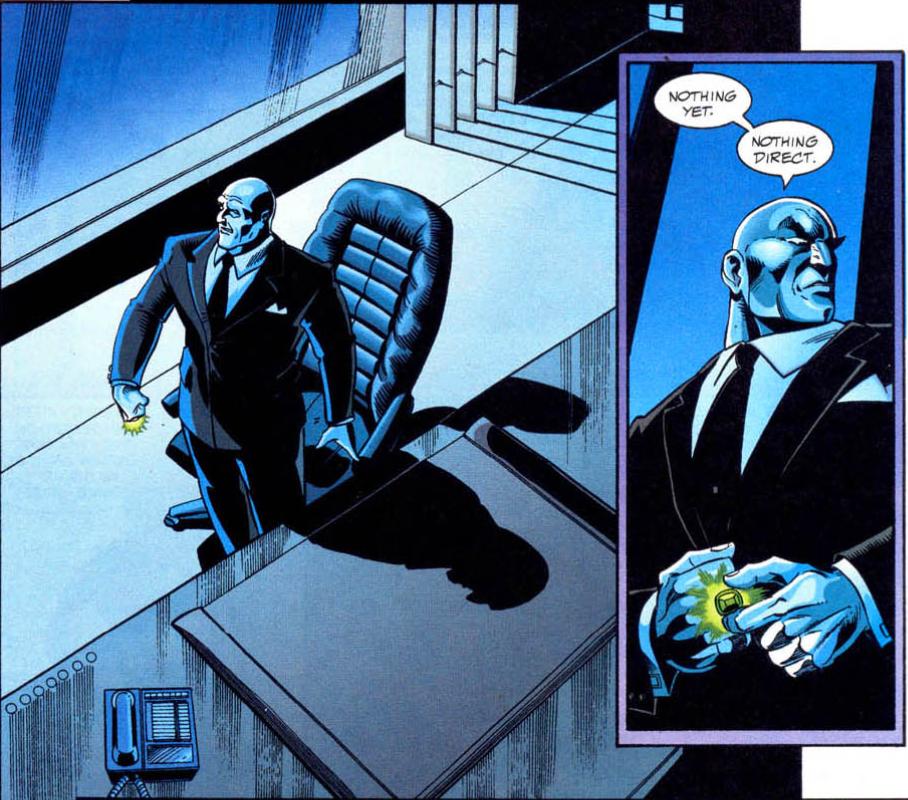
 There are a few continuity errors in this issue. Luthor is shown with his kryptonite ring, an item he wouldn't acquire until Superman #2, a year or so down the line. He's also pictured in his post-Underworld Unleashed body, taller, slimmer and more well-built than his original Man Of Steel body, which was shorter and stockier. Luthor should also have some red, receding hair, and I do get a little irritated when the Luthor from the Man of Steel era is rendered as fully bald, as one of the nice touches throughout the original miniseries was how Luthor gradually lost his hair across his appearances. In a wider DC sense, Ollie and Diana were residents of Star City at this time, not Seattle.
The Geeky Bits: On the topic of Superman and the JLA, around the time of this issue, three Justice League of America story-arcs from the Silver Age featuring Superman as a member/reserve member can be definitively said to have occurred in the Post-Crisis history. The first, issues 96-98 from 1972, contains the original appearance of Starbreaker, who would return in Justice League America #62-65 (1992), Adam Strange: Planet Heist (2005) and Justice League of America #29-34 (2005). The second is issues 120 and 121 from 1975, which featured the marriage of Adam Strange and Alanna. The last, issues 185-187 (1981) show Superman's first time on Apokolips and his first encounter with Darkseid. This story is important, as during the Legends crossover, Superman exhibits knowledge of Darkseid that he would otherwise not have had the opportunity to gain.
Next on World of Superman: I really don't want to do this, but I'm going to have to unleash the continuity-challenged JLA: Classified #49 upon you all. Put on your finest continuity cop uniforms, and meet me back here in a few days time.
I'd also like to return a shout-out to Kevin Cushing of the Geoff Johns Podcast, who read out an e-mail of mine on his second episode and plugged the blog a little. The Geoff Johns Podcast is a new podcast looking at the work of Geoff Johns. In a few episodes time, the podcast will alternate between the current month's worth of Geoff Johns work, and the same month 11 years ago (starting at the beginning of Johns' writing career), but for now the podcast is playing catchup with current titles and storylines to provide context for future episodes. I've really enjoyed the first two episodes, even with the second episode being a Brightest Day catchup (not a fan of Brightest Day, which seems to be heading towards Countdown standards as opposed to 52 standards). I hope you'll be able to find some time to catch this podcast, as once the 'historical' episodes get underway I think Kevin will be covering some really interesting titles.
Anyway, it'll be a very long time before we cover any Geoff Johns work here at the World of Superman. Today, we'll be looking at John Ostrander. Please open your issues to page 1.
 Like A Tombstone In The Sky
Writer: John Ostrander
Penciller: Val Semeiks
Inker: Prentis Rollins
Colorist: John Kalisz
Separations: Heroic Age
Letterer: Ken Lopez
Assistant Editor: Steve Wacker
Editor: Dan Raspler
Cover Artist: Val Semeiks, Prentis Rollins, John Kalisz
Cover Date: September 2001
Release Date: 11/07/2001
Having been established for some time, the Justice League outgrows its original headquarters and builds itself a satellite headquarters in orbit around the Earth. Green Arrow resents the symbolism of the League looking down upon the Earth, and concerns over the 'sitting duck' nature of the satellite. Superman tries to address his concerns, telling him that only the League know that the satellite is there. However, Superman is wrong, as Lex Luthor gains positive confirmation that the satellite exists. He draws his plans against the League.
Green Arrow gives an inflammatory performance during an interview with Tully Reed, criticising the League for getting above its station and not doing enough for social issues. Hawkman takes offence at Arrow's comments, saying that the interview has jeopardised the League's UN backing and funding. He calls for the League to censure Green Arrow, but before they can do so, Arrow quits. Green Lantern follows his friend, and two talk. Green Arrow is having a mid-life crisis, and wonders if he needs the League as much as it needs him. Their conversation is interrupted by an emergency call from Black Canary, who is alone on the satellite and has detected a horde of Kobra spaceships heading towards her. The satellite is boarded and although Canary fights hard, she is overwhelmed by sheer force of numbers, and is captured by Kobra. As the the heroes prepare to rescue Canary, Atom tells the League to rendezvous at LexCorp.
 The League confronts Luthor, who protests his innocence, claiming that Kobra stole LexCorp equipment to mount his raid on the satellite. He then turns on a screen broadcasting Kobra's message to the world - a trussed up Black Canary and an ultimatum for the League to surrender to him. Although they doubt Luthor's innocence, the League realises that Kobra has laid a trap for them. They decide to distract Kobra, and Green Arrow teleports to the satellite to be that distraction. Taking out the first few guards, he fires an arrow into a control panel before announcing his presence to Kobra and drawing his troops. Alone in the control room, the arrow starts to shape-shift - it was really a disguised Martian Manhunter.
Green Arrow is quickly captured, and is beaten and brought to Kobra. Green Arrow taunts his captor, telling him that Martian Manhunter has already disabled his traps and bombs. The League then burst in to confront Kobra, whilst out in space, Superman, Green Lantern and Firestorm take care of the spaceships. With the Kobra troops defeated, the League search for Kobra himself, but find that he has managed to escape. However, they find the badly beaten body of Green Arrow, and transport him to a government hospital for him to receive treatment. Recovering in bed, Arrow decides not to rejoin the League, although Atom tells him that he is family and will always be welcome.
 There's not a huge amount to say about this issue from a Superman point of view. He is listed on the opening splash page as a reserve member, a status he holds with League pretty much until the Watchtower era starts in JLA #1. There's a good moment where Green Arrow is freaking out with the League's self-appointed protectorshipbenevolance and humanity shines through. Green Arrow's response, a semi-mocking 'You're not the same as other people', speaks volumes about how he views Superman.
Although Superman doesn't really contribute to the rest of the plot, he does get to use his powers against Kobra a couple of times. These are nicely rendered by Val Semeiks, who really gives some panache to the battle scenes in the book. I particularly like the splash page where Superman, Green Lantern and Firestorm take apart the Kobra spaceships, especially the bits where Firestorm turns the ships into stone. Semeiks does a great job with the issue, bringing a real sense of unease to Kobra, especially his temple.
The issue opens with the construction of the iconic Justice League satellite, then jumps forward in time with the caption 'Some time later...' on page 8. This leap in time covers the most notable incident to occur on the JL satellite, the rape of Sue Dibney by Doctor Light and the mind-wiping of both Light and Batman. Although not specifically stated in this issue, the League's actions in the aftermath of the assault is the trigger for Green Arrow's feelings towards the League and his actions in this issue.
 There are a few continuity errors in this issue. Luthor is shown with his kryptonite ring, an item he wouldn't acquire until Superman #2, a year or so down the line. He's also pictured in his post-Underworld Unleashed body, taller, slimmer and more well-built than his original Man Of Steel body, which was shorter and stockier. Luthor should also have some red, receding hair, and I do get a little irritated when the Luthor from the Man of Steel era is rendered as fully bald, as one of the nice touches throughout the original miniseries was how Luthor gradually lost his hair across his appearances. In a wider DC sense, Ollie and Diana were residents of Star City at this time, not Seattle.
The Geeky Bits: On the topic of Superman and the JLA, around the time of this issue, three Justice League of America story-arcs from the Silver Age featuring Superman as a member/reserve member can be definitively said to have occurred in the Post-Crisis history. The first, issues 96-98 from 1972, contains the original appearance of Starbreaker, who would return in Justice League America #62-65 (1992), Adam Strange: Planet Heist (2005) and Justice League of America #29-34 (2005). The second is issues 120 and 121 from 1975, which featured the marriage of Adam Strange and Alanna. The last, issues 185-187 (1981) show Superman's first time on Apokolips and his first encounter with Darkseid. This story is important, as during the Legends crossover, Superman exhibits knowledge of Darkseid that he would otherwise not have had the opportunity to gain.
Next on World of Superman: I really don't want to do this, but I'm going to have to unleash the continuity-challenged JLA: Classified #49 upon you all. Put on your finest continuity cop uniforms, and meet me back here in a few days time.
Subscribe to:
Posts (Atom)