Showing posts with label 1986. Show all posts

Sunday, 13 February 2011

Legends #1 and #2

OK, a bit of a long one today. I'm going to try and hit up the first four parts of the Legends crossover in two posts, bringing us up to the point where the Superman titles segue into the story. Before we begin, I'd just like to drop a quick reminder to e-mail Ian Sattler at DC comics in support of a trade paperback of Dark Knight Over Metropolis. See this post on the Superman Homepage for more details.

And now, the first of a two-part special bringing us up to speed on the 1986/7 Legends crossover.


Legends #1

Once Upon A Time...!
 
Plotter: John Ostrander
Scripter: Len Wein
Penciller: John Byrne
Inker: Karl Kesel
Letterer: Steve Haynie
Colorist: Tom Ziuko
Editor: Mike Gold
Cover Artist: John Byrne
Cover Date: November 1986
Release Date: 28/08/1986

On Apokolips, Darkseid is content with his domination. Desaad reminds him of Earth and its heroes. Darkseid notes that not only do Earth’s heroes perform heroic deeds, but they act as legends, inspiring others. Deciding to strike at the concept of legends, Darkseid summons Glorious Godfrey and Doctor Bedlam, and orders Desaad to prepare the Techno-Seed.

On Earth, Professor Stein oversees a nuclear experiment when the Techno-Seed materialises in the core, spawning the inhuman monster, Brimstone. Stein summons Firestorm, who assaults Brimstone, but quickly discovers that the monster is far superior to him. Thinking quickly, Firestorm protects himself by turning the air to asbestos, and goes to summon help.

Elsewhere, the Flash faces off against Deadshot. He quickly defeats the assassin, delivers him to the police, and returns to Titans Tower, where Changeling is watching the latest broadcast from G. Gordon Godfrey, interviewed by Billy Batson, who rails against all super-heroes, calling them threats to society. As the two Titans talk, a power outage strikes both the Tower and the studio where the interview is taking place. The outage is caused by an armoured giant rampaging in the neighbourhood. Under the cover of darkness, Billy slips away and transforms to Captain Marvel.

Captain Marvel and the giant, Macro-Man, fight, but when Marvel is caught in Macro-Man’s vice-like grip, he decides that the only way for him to escape is to change back into Billy Batson briefly. Calling down his magical lightning, Billy is shocked to see that the bolt also struck Macro-Man, causing him to fall from the rooftop to a fiery death.

In the Pentagon, Colonel Rick Flag reports to Amanda Waller, and is ordered to reform Task Force X. He is shocked by the list of candidates for the Task Force, but puts his surprise aside to do his job.

In a diner, Cosmic Boy’s breakfast is interrupted by the onslaught of Brimstone. The Legionnaire attacks, attempting to construct a metallic prison to contain Brimstone, but his attack is soon repelled. The Justice League of America arrive to lend their help.

Viewing the melted corpse of the Macro-Man, Billy Batson vows never to become Captain Marvel again.

Legends #2

Breach of Faith

Plotter: John Ostrander
Scripter: Len Wein
Penciller: John Byrne
Inker: Karl Kesel
Letterer: Steve Haynie
Colorist: Tom Ziuko
Editor: Mike Gold
Cover Artist: John Byrne
Cover Date: December 1986
Release Date: 25/09/1986

G. Gordon Godfrey arrives at the site of Macro Man’s death, using it as an opportunity to decry not only heroes but the concept of being a hero. His words whip the onlooking crowd into a frenzy, scaring the confused Billy Batson into hiding. Darkseid watches Batson’s despair with glee, before turning to the Phantom Stranger, promising to remove free will from the people of Earth.

On Earth, Brimstone faces off against the Justice League of America. Although Vibe is able to topple the giant, Brimstone fights back, burying the League underneath a collapsing building. Meanwhile, Rick Flag visits Deadshot in prison, enlisting him into Task Force X. At the same time, in Gotham, Batman and Robin break a hostage situation. The commander of the arriving SWAT team clashes with Commissioner Gordon when he prevents him from taking down the heroes. Suddenly, the onlooking crowd turns, attacking and carrying Robin away whilst Batman is unable to help when a bottle of perfume is smashed in his face.

In Chicago, Blue Beetle carries out a drug bust, but unwittingly exposes a deep cover police officer. The attending policemen open fire on Beetle, who escapes in his bug ship. Meanwhile, Guy Gardner rescues an aeroplane whose engine has exploded mid-flight, guiding it to a makeshift landing on the freeway. However, the commuters on the road turn aggressive at the disruption caused to them. Gardner uses his ring to repel them before flying away.

At Titans Tower, Cosmic Boy recovers from his combat with Brimstone, revealing to Flash and Changeling that the Justice League had disappeared by the time he came round. He flies off to rescue ‘the love of his life’. Watching news reports of the League’s defeat, Professor Ivo prepares to make his move.

Superman meets with President Reagan in the White House, where Reagan informs him that he is about to issue an executive order, banning all super-hero activities until the public disorder has passed. Later in Gotham, two policeman discover the battered and beaten body of Robin.

These first two parts of the Legends crossover take a very wide-angled view of the state of the DC Universe. reading with hindsight reveals some strong comparisons, especially the way that the then-current Justice League (Detroit) fares against the yet-to-be-formed Justice League International. The defeats of the heroes hurt. The entire League is beaten and missing in battle, whilst Billy Batson's pain at believing that he has killed the Macro-Man is very tangible. Other heroes find themselves lost and without a cause when faced with the negative reactions of the public. By the end of the second issue, where Superman bows his head in acceptance of President Reagen's executive order and Jason Todd lies unconscious in the street, there is a very real sense that the tide has turned against the heroes.

John Byrne draws the heck out of these issues. I do marvel at his ability to turn out great-looking comics. At the time of this issue's production, Byrne was likely working on the first few issues of Superman and Action Comics, yet he still found the time to produce six issues showcasing almost every major hero in the DC universe. In particular, Byrne's renditions of Darkseid are masterful. In fact, I'd be happy to list Byrne as one of my top three Darkseid pencillers, along with JG Jones (Final Crisis) and Jack Kirby. Byrne gives us an intricately detailed Darkseid, with maliciousness oozing from every frame. When Darkseid grins, it's a grin that should terrify any onlooker. The final panel of issue #1, with Darkseid looming in the background revelling in the success of his plans, could easily have looked goofy in the hands of a lesser artist, but a rarely-seen laugh from Darkseid here chills the reader. And the opening shot of Apokolips, from the first page of issue #1, is glorious.

Inevitably, there are things that don't work so well for me. I wasn't reading the DCU when the series first arrived - it would have been quite an achievement considering I was 3 1/2 at the time - and a lot of the wider picture of the DCU is lost on me. As always, some of the Fourth World designs look incongruous and a product of their time, although Glorious Godfrey is far more sinster and insidious as G. Gordon Godfrey than as his cloak-wearing, grinning Apokoliptian incarnation. And most annoyingly of all, the Phantom Stranger pops up in issue #2 for no adequately explained reason, giving Darkseid someone to boast to and turning his campaign against Earth's heroes into something more akin to efforts to impress an unimpressed colleague.

These complaints aside, these are strong issues, featuring super-hero action and a strong, logical drive to the plot and threat. What is really enjoyable is watching Ostrander pull task Force X together, and next time, we'll see how well they do on their first mission.

The Geeky Bits:

Legends was the first event for DC, following Crisis on Infinite Earths. Originally planned as more of a direct sequel, Legends eventually grew to be its own unique story. John Byrne was picked for the art, although his workload with Superman meant that he only had time for 6 issues, not the planned 8. This reduction in length may account for the confusing nature of the Phantom Stranger's appearance in the story, with his introduction a casualty of editing the story down.

A large number of DC titles crossed over into Legends, with 22 official tie-ins alongside the six issue miniseries. A full list can be found at the DC Crossover Checklist over at the Fortress of Baileytude.

Next on World of Superman: See how Earth's heroes react to an executive order banning their actions, how Task Force X fare on their first mission, and what leads Darkseid up to focusing his attention on Superman.

Sunday, 14 November 2010

The Man Of Steel #6

If it's Sunday night, then it must be time for a posting. Hey, I kept to my schedule for an entire week!

I've been having a bit of a Superman-heavy week this week. I've been re-reading the entirety of Time and Time Again to allow me catch up with 3 weeks worth of From Crisis To Crisis, approximately 7.5 hours of podcasting. I had suffered one of my periodic itunes library crashes, and in the course of attempting to restore all my user-created data, especially my playlists, I accidentally deleted my podcast folder, along with all of my active subscriptions. I've got them back, but I had a wonderful bug with FCTC that resulted in every episode attempting to download at once, even though I only clicked the 'subscribe' button. So, Michael, Jeffrey, that huge volume of downloading that made your stats look good last week? That was me. Sorry!

Anyway, I got caught up, just in time for them to release another episode, so I had to do the reading and more listening. The blog got another brief shoutout, although I am a little concerned that my last two podcast shout-outs have resulted in the hosts forgetting the name of the site! This little mishap aside, the episode was great, and a rarity for FCTC as they got to spend the entire episode working with comics that they didn't like so much, which was a nice change of pace.

All this rambling aside, I've also been looking at the final issue of The Man of Steel, also the final issue before we hit the relaunched titles from January 1987. Come and take a look with me!

The Haunting


Written and Pencilled by John Byrne
Inked by Dick Giordano
Colored by Tom Ziuko
Lettered by John Costanza
Edited by Andrew Helfer
Cover Art: John Byrne
Cover Date: December 1986
Release Date: 25/09/1986

Superman returns home to Smallville, changing to Clark Kent at super-speed to give the appearance of him arriving at the bus station. As he and his parents make small talk on the way to the farm, Jonathan is quickly silenced before he can give something away. Over dinner, Clark lays out his problems with Lois, the fact that she both resents Clark for scooping her on the Superman story, and her gentle infatuation with Superman.


That night, unable to sleep, Clark sneaks downstairs for some pie. He is surprised to see a ghostly apparition in the kitchen that speaks to him in an alien language. The apparition reaches out for Clark, and as soon as it touches him, Clark finds himself on another planet, dressed in his Superman costume, and able to speak the alien language. A figure approaches him and mistakes him for Jor-El. Realising her mistake, the figure realises that Clark is her son. As Clark tries to process this, he suddenly snaps back to Earth and sees Lana Lang in front of him.


Clark has been sleepwalking during his experience and has ended up at Lana's house. As he gets his head together, he asks Lana what she is doing back in Smallville, as she had left years ago. Lana reminds him of the last time they met, years ago. On the night he discovered that he was adopted and an alien, Clark turned up at her house late at night. They went for a walk, and Lana started to wonder if he was going to propose to her. Instead, Clark took her in his arms and flew into the sky with her. Landing, he gently kissed her goodbye, and left Smallville. Unsure of anything, Lana felt lost and confused, and it took many years for her to come to terms with what had happened.


Parting on good terms, Clark changes to Superman and returns to the field where the birthing matrix crashed. He is surprised to discover that the matrix has disappeared. As he starts to investigate vehicle tracks, the apparition appears again. He touches Superman, causing him to collapse in pain as images and information streams into his mind. Jonathan and Martha arrive, having spent the day searching for Clark in the truck. Seeing the apparition apparently attacking Superman, Jonathan grabs a shovel and whacks the apparition, causing it to disappear in a flash. Superman reveals that the apparition called him 'his son', and flies away to think about what just happened.


As he flies, Superman realises that the apparition and the woman were his real mother and father, Lara and Jor-El. He discovers the story of Krypton, its tragic end, and the fact that he is the last survivor of his world. He can now speak Kryptonian, and has knowledge of Krypton's culture. He lands on a mountain and decides that although his true parents are Kryptonian, and it is his heritage that grants him his powers, it is his upbringing that makes him who he is.

And so it ends as it began, in the fields of Kansas. There's a lovely circular feeling to this issue. After spending most of the series in Metropolis cementing Superman's role in the city and the wider DCU, it's a strong choice to bring him back to Smallville and participate in what is ultimately a very small-scale story that completely defines Superman for years to come.

This issue has three objectives: Introduce and define Lana's place in the new Superman mythos, grant knowledge of Krypton to Superman, and redefine Superman in light of this new knowledge. The Lana scenes work very well. It is revealed that Lana is the person Clark goes to visit back in The Man of Steel #1, and we see what happened that night. Lana's conflict is well-portrayed. Her confusion comes across, even as she rationalises it with the benefit of hindsight. Hers is only a small scene, but it is one of the most important in the whole mini-series. Their discussion concerning Clark's dual responsibilities define his approach towards Lois Lane for the next few years, as he balances both sides of his life. It also helps give Lana definition beyond 'Superboy's Girlfriend', allowing her to move beyond her teenage attraction to Clark and be a strong supporting character in her own right.

The second objective is rather clever, and leads directly into the third. By this point in the series, the reader knew everything that there was to know at the time about Krypton, but Superman hadn't really confirmed that was extra-terrestial. The way that Byrne introduces this knowledge to Superman is deliberately non-specific, allowing for future revelations about Krypton's past, such as the contents of the World of Krypton series, to be available to Superman. It is this info-dump that most likely provides the information for Superman to relay to Lois Lane in that series. But this is more than just dropping the knowledge of a dead people into Superman's mind. The moment where he glimpses Lara and realises her identity is beautiful but brief, whilst the appearances of Jor-El plays into the fears we have seen across this project that Superman's presence on Earth is part of a larger plan (such as J'onn's fears in Martian Manhunter #20, and the drive Superman has exhibited at times to define his origins). Although we have seen that Jor-El's intentions are benevolent, Superman walks away from this issue unsure about his biological father.

The key scene of this issue is the climax where Superman flies around whilst debating the information he has just discovered. The final panel, where Superman declares that although Krypton made him Superman, it is the Earth that makes him human is the single most defining moment for the post-Crisis Superman. In effect, Superman is stating the key principle for Byrne's rebooting of Superman, that the human side, Clark Kent, is the primary definition of character; the hero, Superman, is one part of this character. For many fans, a story that deviates from this simple statement of principle is one that they would prefer not to read, and quite often I am one of them.

The art in this issue is fantastic. Byrne is at the top of his game. The contrasts between the futuristic Krypton and the urban Smallville are strong, and the faces of the characters, especially Lana, sell the words with utter conviction. But it is the final pages again that are the real highlight of the book. Byrne has given himself the opportunity to draw Superman in his element, flying across the globe. The panel at the bottom of page 20 where Superman briefly enters orbit is beautiful to look at, but even this pales in comparison to the final image of Superman standing tall on a mountain top, having reconciled his alien and human origins. Iconic is a word that is used far too frequently, but it applies to this image absolutely. Superman has rarely looked better.

The Geeky Bits: One plotline bubbling throughout The Man of Steel, the mysterious figure who observed Clark encountering the matrix for the first time, who took photographs of Superman in Metropolis, and who stole the birthing matrix, would be resolved in Superman #1.

The placing of this issue in context of the rest of The Man of Steel is hard to do, as no dating information is given within. However, Superman: The Man of Steel Annual #4, published in 1995, recaps this issue, and suggests that these events take place seven years after the events of The Man of Steel #3. Some people have taken this to mean that the span of the entire Man of Steel mini-series is 7 years from the first appearance of Superman at the end of The Man of Steel #1, but this actually suggests that the series lasts for the best part of 8 years, as Superman's encounter with Batman in The Man of Steel #3 takes place 8 months after Superman's first appearance. Ah, dating, ya gots ta luv it! However, I subscribe to the idea that no more than 7 years occurs between Superman's first appearance and the events of this issue, mainly because the idea that Superman was active for 7 years without encountering any major super-villains with the exception of the pseudo-Bizarro feels like stretching credibility enough without adding the best part of another year on!

As a side-note, one of the more interesting comparisons between Superman and Batman is that within months of Batman's first appearance, his major villains were starting to appear, both the psychos and the metas. In contrast, Metallo, Superman's first recurring super-powered villain, took seven (or eight, see above) years to appear. I find that an interesting statement on the nature of both Superman and Batman, and their respective cities.

This issue, along with issues 3-5 were covered on the second episode of From Crisis to Crisis, which can be found here.

The most recent printing of The Man of Steel in TPB form was the first volume in the six-volume series collecting the early issues of the post-Crisis Superman. (Yes, that's not the cover, but Amazon was being a pain and kept linking this, and I rather like its simple iconography).

Next on World of Superman: Phase one of the blog is over. Phase two begins. Superman #1. And at some point over the next few weeks, a special post for continuity nuts that will re-order some of the issues that slot in between individual issues of The Man of Steel. I've been busy!

Saturday, 6 November 2010

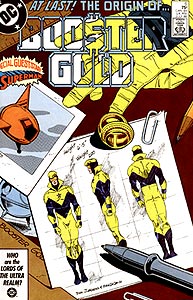
Booster Gold #7

Well, I'm back. I hope you enjoyed my random mutterings on the MCM Expo. I also hope you found the time to listen to the latest episode of Awesomed By Comics. I sent Aaron and Evie an e-mail about my encounter with Kieron Gillen (Have you read Generation Hope yet? Oh, go on, it's great!) which they then read out on the show whilst also giving the blog a gentle plug. Well, once they worked out what the site address was! There was a slight miscommunication that made it sound like I had asked Kieron to sign my copy of Phonogram with a reference to their podcast, whereas the dedication was all Kieron's idea, based on our chat. Let's face it, if I'm going to claim credit for someone else's ideas, I'll probably choose someone less  well-known than Kieron Gillen!

I also got the chance to read Superman: Earth One. I'll not go into too much detail, save to say that I really enjoyed the first half of the issue, especially the bits where Clark slowly found his feet in Metropolis, but once the aliens turned up to invade, my interest started to wane. The art was wonderful, although the final reveal of Superman made him seem just a little on the weedy side. What did take me by surprise this week was Superman #704, which was one of the best fill-in issues I've read in a long time. It served the wider story, but put a long-overdue focus on the Clark and Lois relationship. For the first time in years, I found myself really believing in their relationship.

And now, an apology. As I've mentioned before, I work in retail, and the next eight weeks are the busiest weeks of the year for me. I'm also angling for a promotion, and with this on top of the pre-Christmas trading, I'm working an insane amount of hours. Therefore, in order to alleviate my guilt at not keeping to the regular, twice-weekly schedule that I would like to, I'm going to scale back my blogging activities over the next few weeks. I won't be giving up the blog, as I really enjoy both writing these posts and my behind-the-scenes oh-so-secret project that only two people out there know about, but I'll need to reduce my schedule to a weekly basis in order to be able to get through the next two months. Still, this should see us through to Legends quite nicely.

And finally, my scanner is playing up again, so no scans today. Go and grab the Showcase Presents: Booster Gold collected edition if you want to see what this issue looks like.

The Lesson


Creator-Writer-Artist: Dan Jurgens
Inker: Mike DeCarlo
Letterer: Augustin Más
Colorist: Gene D'Angelo
Editor: Alan Gold
Cover Art: Dan Jurgens, Mike DeCarlo
Cover Date: August 1986
Release Date: 15/05/1986

Booster Gold, Skeets, Fern and Zee have been taken to the planet Vellar, in a remote part of the galaxy, where they are interrogated by Lord Galeb. They discover that powerful magic has given them the ability to understand the alien language, as well as reducing them in size so that they are the same height as Zee. Lord Galeb, leader of the planet, accuses the heroes of treason, having aided and abetted Zee, who is a traitor, a charge he admits. Booster and Superman attempt to break free, but Galeb's consort, the wielder of magic, brings them down with a magical blast.


In a prison cell, Zee tells of how he attempted to overthrow Galeb's monarchy to free his people from tyrrany. When the revolution failed, Galeb executed Zee's wife and children. Booster wants to head back into action and overthrow Galeb, but Superman counsels holding tight and not interfering in the internal power struggle of the world. The two argue until Galeb arrives to free them, having had his consort telepathically probe them whilst they were unconscious and having discovered their innocence. Booster Gold wants to stay behind and work to overthrow Galeb, but Superman's morals lead him to step in and restrain Booster. The two fight, with Booster throwing everything at Superman, determined to replace the government on Vellar. Skeets speaks to Galeb, before interveneing in the fight by disabling Booster's technology. Booster is angered at his friend's 'betrayal', but when Skeets reveals that Zee never had a family and had been lying to him all the time, Booster hangs his head in shame before apologising to Galeb.


Back on Earth, Lois Lane arrives for a pre-arranged interview as Superman and Booster return from Vallar with Fern. She comments to Superman that he is yesterday's news compared to Booster, but that Booster might not have the staying power of Superman. As she and Booster head off for the interview, Superman confirms with Skeets that Booster's presence in the 20th century is part of historical record and not an paradox. As he leaves, he warns that if Booster uses his knowledge of the future for destruction, he'll have to reckon with Superman.

It's taken a while to get this entry done and dusted. There have been some real life issues, details of which have been given in previous posts, but there has also been one significant factor at play: I don't particularly enjoy this book and find myself fairly uninterested in it. That's not to say that there isn't interesting stuff in here, but the main focus of the plot, the runaround on Vallar, is so generic it hurts.

Part of my problem of this issue is the way that the strongest elements of the previous issue are jettisoned here. The character of Fern, our introduction to this story, plays almost no part in this issue beyond reminding the reader of how he is able to survive in an alien atmosphere. There is no reaction from Fern when Zee is revealed to be a liar and the antagonistic force on Vallar, and he pretty much disappears off-panel on the return to Earth. Also gone is the rich characterisation of Booster that was introduced last issue when his origin was revealed for the first time. Here we are given a hot-headed and arrogant Booster, although he has the grace to show humility when Zee's true colours are revealed. It is hard to disagree with Superman's assesment of Booster Gold throughout, which is suprising considering that this is Booster's book. It's a shame that what was such an important story for Booster Gold in issue #6 should finish with such a weak second part.

The Geeky Bits: The cover to this issue would be neatly reversed by John Byrne when Booster and Superman meet again in Action Comics #594.

Next on World of Superman: It's finally over. The first chapter in World of Superman draws to a close as Superman learns what have known for over a year now when he encounters the image of his father in The Man of Steel #6.

Thursday, 7 October 2010

Booster Gold #6

This blog post has had a pretty tortured history. I had a chunk of it written, and then blogger had a fit and deleted a bunch of it. I then tried to get it written again, but blogger wouldn't let me edit or create new posts. After quite some time, I discovered that my browser was at fault, having crashed whilst attempting to update. This happened whilst I was away from my desk, so I had no idea about the update, until tonight when a little popup informed me. So, we're back, but a little behind schedule.

One of the things I got the chance to do whilst not blogging was to take a look at the latest episode of Smallville. As normal, there were things I liked and things I disliked, and as normal, the big money-shot moments just seemed to come across as a bit flat. I really dislike this new version of Cat Grant. The super-bubbly-perky character, the relentless parroting of 'Godfrey' (if she's such a hotshot young reporter, shouldn't she have her own opinions?), the forced pairing with Clark. I would be happier if they wrote the character as a normal person with the views that she has, and let the performance lead the irritating side of the character. I also found the 'lifestyle' comments regarding vigilantes to be incredibly heavy-handed. It's been covered elsewhere in more detail, but I also need to point out that Deadshot and Jonah Hex are two different characters, and nothing is gained by combining the two. And the revelation of the new costume for Clark was spoiled by some really bad CGI, especially on the flags waving limply in the background.

What I absolutely loved about the episode was the Carter Hall/Lois Lane subplot. Michael Shanks was great in Absolute Justice, but playing the identity rather than the hero really gave him the chance to shine. I loved his annoyance at Lois in the first scene, but what really sold me was the closing scene where he wonderfully conveyed centuries of love and loss. Erica Durance as Lois Lane has come on by leaps and bounds since I last really saw her in the role, back when she was first introduced. For probably the first time since the early days of Lois and Clark (or The New Adventures of Superman, if you're British), I was watching the Lois Lane that I have read for years in the comics. I wasn't expecting to be this impressed by her, but she is something I will enjoy watching in future episodes.

I also read the recent JLA/JSA crossover, but if you want to know about that, check out this episode of The LanternCast. The poor guys did the episode once, then lost the episode before it could be released, so they had to do it all over again. And the only way one of them could cope was... well... let's just say he wouldn't have been driving that day!*


To Cross The Rubicon


Creator/Writer/Artist: Dan Jurgens
Inker: Mike DeCarlo
Letterer: Augustin Más
Colorist: Nansi Hoolihan
Editor: Al Gold
Cover Art: Dan Jurgens and Mike DeCarlo
Cover Date: July 1986
Release Date: 14/04/1986


Jason Redfern (Fern), a teenage boy, discovers a miniature spaceship in Centennial Park, long with a miniature alien. The alien’s language cannot be understood, so Fern calls him ‘Zee’. When Zee pushes him out of the way of the exploding space-ship, Fern is convinced of his good intentions, and takes him home. At home, Zee projects an image of Superman’s ‘S’ shield, which Fern interprets as Zee’s desire to locate Superman. Catching an advert featuring Booster Gold on the television, Fern realises how to get hold of Superman. He travels to Reilleau Towers, where he is able to see Booster and tell him his story. Booster then publicly calls Superman out through the media to meet him the next day.

The next day, the media is buzzing with Booster’s decree. Clark Kent hears about it at the Daily Planet, and sneaks away to become Superman. Booster Gold arrives at the rendezvous point, having stopped off at STAR Labs to grab a life-support suit for Fern. Although Skeets is sceptical about whether Superman will show, the Man of Steel arrives. Superman is disdainful of Booster, his publicity seeking ways, and the fact that his powers are artificial. Disappointed in the reactions of his hero, Booster walks away. Skeets speaks to Superman, and reveals the secret origin of Booster Gold.

Michael Carter was a prodigious football player, the biggest name in college football in the 25th century. As he was on the verge of being signed up professionally, he was caught betting on his own games, and expelled from college. With no further hope as an athlete, and needing to make a living, he took a security job at the space museum, as well as enrolling as a student of 20th century super-heroes. Whilst participating in the studies and his duties at the museum, Michael formulated a plan, cemented when he discovered Rip Hunter's time machine in the museum. Disabling the security robot Skeets, Michael steals various exhibits to create a power suit, then travels back to the twentieth century in the time machine, taking Skeets along with him.

Superman is shocked to hear this, and accuses Booster of theft, and using the stolen equipment to make himself rich. As the two argue, Zee starts speaking. Superman recognises snatches of the language, and is able to discover that a warship is chasing Zee. Suddenly, an energy burst renders Superman, Booster and Fern unconscious. Another miniature alien appears, abducting the heroes, Fern, Zee and Skeets onto his ship, which departs for space.

pre-dates The Man Of Steel #1 by three months, meaning that we have here the very first appearance of the post-Crisis Superman. Booster does it again! This also means that Dan Jurgens debuted his art for Superman before John Byrne, and it's great art. His first panel, featuring Clark changing to Superman in an interpretation of an iconic pose, is wonderful to look at, and as fans of this era know, Jurgens' Superman art is a real keystone of the next fifteen or so years of the character.

This is a great Superman issue, and fits neatly into the timeline between The Man Of Steel #5 and #6. Superman here is confident in his position in the world, having already met and worked with one wave of heroes. Now, with the appearance of Booster Gold several years into his own career, Superman is starting to encounter the next wave of heroes, people whose motivations lie in places other than benevolence. His outrage at Booster's self-centered money-making activities, all of which stem from theft, is entirely justified, and comes from a place of confidence in not only himself but his position in relation to other heroes. The first panel in which Superman appears, a one-page splash where he stands above Booster, looking down with an expression of derision, neatly sets up how he feels, and completely wrong-foots Booster, for who Superman is a personal hero.

Of the two parts of this story, I feel that this is the stronger of the two. We get the first revelation of Booster's origin, devoid of the later embellishments and cliches that Booster would add, and the force of Superman's anger towards Booster has a powerful effect on the reader.

The Geeky Bits: Booster Gold is pretty much the first post-Crisis superhero, despite his first issue being released before the Crisis had finished publication. He has been a mainstay of the DCU, thanks to his high-profile membership of various incarnations of the Justice Leagues from the JLI onwards. He was also the first solo creation of Dan Jurgens for DC, but as before, I'm going to hold off on a full bio of Dan for a bit longer.

The title refers to the Rubicon river, which was crossed by Julius Caesar in 49BC, initiating a civil war. In general, the phrase 'To cross the Rubicon' refers to the point of no return, in this case the moment where Booster travelled in time to the twentieth century.

Next on World of Superman Booster Gold: The second half of this tale where Booster smacks down with Superman. Unless you've seen the cover, in which case you'll see that it's more a case of Superman smacking Booster down. Ouch.

*worldofsuperman.blogspot.com does not condone excessive alcohol consumption for the production of podcasts, blog posts, tweets, or any other type of new media (unless it's Lit Beer: My beer).

Monday, 4 October 2010

The Man Of Steel #5


Happy birthday to you,
Happy birthday dear worldofsuperman.blogspot.com,
Happy birthday to you.


Yes, believe it or not, it's been a year since the World of Superman snuck onto the blogging scene. In that time, we've covered the death of Krypton, affairs with Lex, the birth of the Heroic Age Silver Age, Superman joining - and leaving - the Justice League of America, some very bad comics, and most of all, the introduction of Superman to the DC Universe. We've also suffered some dramatic delays to posting, which I very much hope will be a thing of the past. Sadly, I missed my self-imposed target of completing The Man of Steel by the time the first anniversary came around, but that was as much down to me having my dates all wrong as anything else.


So, we're back with The Man of Steel, and we're going to finish it in the next few posts before moving onto the regular series. Well, apart from a couple of diversions. But it wouldn't be the World of Superman if we didn't detour along the way...


The Mirror, Crack'd...

Script and Pencils: John Byrne
Inking: Dick Giordano
Lettering: John Costanza
Coloring: Tom Ziuko
Editing: Andrew Helfer
With special acknowledgement to the work of Otto Binder
Cover Artist: John Byrne
Cover Date: December 1986
Release Date: 11/09/1986

Superman returns a LexCorp-built battle armour suit to Lex's penthouse. Luthor claims that the suit was registered as stolen, and that the pilot was fired from LexCorp weeks ago. Sadly, the pilot cannot corroborate Lex's story as prolonged exposure to the suit has left him brain-dead. As Superman flies away, Lex heads into his laboratory and talks to Doctor Teng, who tells him that his scans have revealed that Superman is not a mutated human, but an alien. Lex asks how this will affect the duplication process, and Teng replies that they will see. A chamber opens, and an exact replica of Superman steps out. After a few seconds, the replica collapses, its body crystallising. Luthor is disappointed and orders that the duplicate be destroyed.


In Metropolis, Lois Lane prepares to leave for work. She argues with her sister Lucy, who is bitter about her blindness. Outside, an ambulance gets stuck in traffic. Suddenly, it is lifted above the streets and dropped off at the hospital. The EMTs prepare to thank Superman, but are shocked to see that a monster has saved them. As 'Superman' flies away, he saves the life of Lucy Lane, who has thrown herself off of Lois' balcony. 'Superman' flies away, as Lucy wonders why he was so dusty.


At the Daily Planet, a disturbance in the lobby causes Clark to run out of the newsroom. He confronts the source of the disturbance, the distorted Superman who has partially disguised himself as Clark Kent. 'Clark Kent' wallops Superman, sending him flying out of the Daily Planet building. As the two fight, 'Superman' uses his heat vision on Superman, causing him intense pain. As they fight, Superman notices Lois watching, and uses his heat vision to destroy 'Clark Kent's clothing to protect his identity.


'Superman' grabs Lois Lane and flies away with her. In the air, he gives her a kiss, before taking her to her sister. As Superman arrives, Lucy explains that since 'Superman' saved her, she has been able to see shapes and shadows. The two Superman fight some more. Superman analyses the dust that falls off 'Superman', and discovers that his foe is not an organic creature. Deciding that he is not truly alive, Superman charges him with all of his might. The impact causes 'Superman' to explode, showering the neighbourhood with dust. Exposure to the dust restores Lucy's sight. Superman wonders if 'Superman' knew of the healing powers of his dust when he died.

For an issue of one of the most notable Superman mini-series ever published, there doesn't seem to be a whole lot to say about it. Of all the issues, this is the most 'business-as-usual', with its notable first occurrences being rather understated.

I think the problem with this issue is how little has carried over into the continuity of the comics. Lucy Lane has her blindness cured and stops being suicidal in this issue, and her blind period is rarely referred to again. Of course, in terms of things about Lucy Lane that are never mentioned again, her blindness comes in a distant third to her marriage to Ron Troupe and her child. We also have the revelation to Lex Luthor that Superman is not human in any way, that he is an alien. Having Luthor in a position where he knows more about Superman's origins than Superman does is potentially an interesting status quo, but this doesn't last beyond the next issue.

Superman faces a being whose powers match his own for the first time here. Although he has fought aliens and encountered New Gods, this is the first time that he feels his own powers being used against him. He is concerned for his well-being, and feels pain, possibly for the first time, when 'Superman' unleashes his heat-vision on him. However, this encounter is soon forgotten. When Metallo attacks in Superman #1, he wonders when the last time he was hit so hard was.

Perhaps the biggest event in the issue which fails to carry over into the ongoing series that followed The Man of Steel is the bogus 'Superman', or as fans know him better, Bizarro. He is never named in this issue, and it's another eight years until the character returns. The character is also played down in a more muted fashion. Most of the bizarre elements associated with the character, from the reverse-speak to the literal Bizarro-world, are missing. Instead, this version of Bizarro is very much a Frankenstein's monster, misunderstood and unable to comprehend the results of its actions, except possibly in one moment of realisation and sacrifice. However, the encounter doesn't seem to phase Superman at all. Having deduced that 'Superman' is an artificial being, Superman shows no signs of following up his appearance. He seems to accept that such warped doppelgangers exist, and that having got rid of one, he has faith that there will be no more.

There is an interesting moral dilemma for Superman that occurs during his fight with 'Superman'. Realising that only one of them will walk away from the fight, Superman examines the dust that 'Superman' sheds wherever he goes and theorises that he is an artificial being, and thus, not being alive, can be killed. Once Superman has made this distinction, he is able to use levels of force that he would otherwise be unable to use against a living being, no matter how dangerous that being may be. In short, Superman is able to terminate 'Superman' for the greater good without any of the guilt that would follow the next time he decided to kill.

These issues aside, there are some strong moments in the issue. We get a good look at how Lois and Clark function in the Daily Planet newsroom, and we also get the first instance of Clark abandoning the newsroom to address a problem as Superman. Lucy's suicidal tendencies, whilst melodramatic, are a hint to a darker type of storytelling to that normally associated with Superman. The same goes for the implication that Luthor deliberately caused one of his henchmen to suffer brain damage in one of his schemes to better Superman. And whilst Superman's fears for his mortality in his fight with 'Superman' aren't as pronounced as the ones he felt whilst stranded in space in Action Comics Annual #7, the art and writing effectively communicates the feeling that Superman is out of his comfort zone.

The Geeky Bits: The Special Thanks credit for Otto Binder refers to the fact that this issue's plot owes a lot to the original appearance of Bizarro in Superboy #68 from October 1958. There, as here, Bizarro is very much cast in the Frankenstein's Monster role, and the subplot involving a blind girl is shared between the two stories. The more familiar version of Bizarro wouldn't appear until Action Comics #254 in July 1959.

This is the first of three post-Crisis version of Bizarro. 1994 saw the publication of the Bizarro's World story, in which Lex Luthor II recreates the duplication experiment, but with similar failure. The current version of Bizarro debuted in the Emperor Joker storyline from 2000, where he was a creation of The Joker, who had been infused with Mr Mxyzptlk's powers, and this incarnation has regularly appeared in the Superman books since then.

Next on World of Superman: A mere six months after reviewing The Man of Steel #1, we finally reach the conclusion veer off one more time to examine the first post-Crisis appearance of Superman.

Sunday, 6 June 2010

The Man Of Steel #4

Enemy Mine...

Story & Pencils: John Byrne
Inks: Dick Giordano
Colors: Tom Ziuko
Letters: John Costanza
Editor: Andrew Helfer
Special Thanks to Marv Wolfman
Cover Artist: John Byrne
Cover Date: November 1986

Lois Lane unexpectedly arrives early at Clark Kent's apartment, taking him by surprise as he hasn't finished getting ready yet. He invites her in, and she takes a good look around, taking in the neatness, and the mementoes of Clark's High School football days. The two have another argument about Clark's scooping of Lois, even though it was eighteen months ago, and in frustration Lois gives up, allowing Clark to finish getting ready. Clark shaves using his heat vision and a fragment of metal from the ship he arrived on Earth in, and in no time at all is dressed up in his finest evening wear. Lois leads Clark to the roof, where a private helicopter from Lex Luthor is waiting to escort them. The chopper flies out over the bay and lands on a giant yacht, where Lex Luthor is holding a fundraiser.


A steward leads Clark and Lois to Lex, as the two reporters discuss Lois' relationship with Luthor. They enter Lex's suite, and meet Lex, the first time for Clark. Luthor congratulates Clark on the Superman story, but when news of Mayor Bewkowitz's arrival on the yacht reaches him, he asks Clark to leave so that he might have a private word with Lois. After Clark has left, Lex complements Lois on her dress, which he has gifted to her. Lois is surprised, as she thought it was just a loaner. The two argue, and Lois storms out, pausing only to step out of the dress and to grab Clark's jacket for decency, and to take a cheap shot at Lex's balding head.


As Lois charges down a corridor, she comes face to face with an UZI. A bunch of hijackers have taken control of the ship. Clark gets between them and Lois, but is pistol-whipped unconscious, and is dumped over the side. Panicking about Clark, Lois is manhandled up onto the deck and is placed with the other passengers. Luthor is nowhere to be seen. Suddenly, the deck tilts, and the ship rises out of the water. Lois takes advantage of the situation to overpower one of the hijackers, grabbing his gun and using it to keep the hijackers at bay. Superman is underneath the ship, carrying it to the harbor of Luthor's private island, the ship's original destination. Setting the yacht down in the water, Superman races to the deck, just in time to save Lois from one of the gunmen that she had overlooked.


Lex Luthor appears on deck, ecstatic at Superman's intervention, and brandishing a cheque for $25,000. Superman refuses, as he is not for hire. Lex continues to press his offer, pointing out that Superman won't be a private security guard, as Lex has his own security force. Lois wonders where they were during the attack, and Lex reveals that he not only knew that an attempt might be made on the yacht, but that he ordered his own security to hold back to allow Superman to show what he could do. Superman, Lois, and the Mayor are outraged at Lex's casual attitude to the life-threatening situation they were all in, but Luthor is uninterested - after all, he is the most powerful man in Metropolis. 'Not any more', says the Mayor, who authorises Superman to arrest Lex. Luthor is taken to Metropolis, photographed, and thrown in a cell.


Three days later, Superman flies into the subway to locate and help a pregnant woman who had gone into labour on a train. After getting her to hospital and making sure that she is OK, he walks out onto the street, where suspects that he is photographed, even though he cannot locate the photographer. He is accosted by Lex, who warns him that he has made a mistake. The people of Metropolis have forgotten who their master is, and he intends to remind them. From this moment on, Superman is a dead man.

Ah, this is more like it. Of all the issues of Man of Steel, I feel that this is possibly the most important of all. Without this issue, nothing that follows over the next decade makes as much sense. It is here that the seeds of Luthor's hatred of Superman are sown (and, indeed, said seeds take root, put forth shoots, and blossom, even though the harvest would be long and fruitful... enough with the seedy metaphors!) in a logical and compelling fashion. Prior to the Crisis, the only lasting explanation for Luthor's hatred of Superman was that Superboy was involved in a lab accident that caused Lex to lose his hair. Here, Lex is already not a nice person, but his mis-judgement of Superman's character and morals leads to a very public and embarassing downfall, one he blames entirely on Superman, and which fuels his decades-long obsession with the Man of Steel. Of all the changes made in Man of Steel to established continuity, this one was possibly the greatest and most impactful. In all major Superman media produced since 1986 (Like Bryan Singer, I'm discounting Superman IV), Lex Luthor is a man of business who has made his fortune legitmately (well, mostly legitimately...), who develops an obsession with Superman when he realises that he is no longer the top dog in town. As someone who came into Superman through the Death, going back and watching the original Superman film is tough, not because the effects and style of storytelling is from a different era, but because Lex Luthor just doesn't match up with my knowledge and expectations of the character.

This is completely Lex Luthor's issue, his introduction to modern continuity, and his first very public fall from grace. He's on sparkling form here, exalting in his power and his perceived untouchable status. His threat is very much that of a shark - graceful and powerful but with a distinct feeling that he could turn on your in a second and destroy your life. He is callous and manipulative, toying with Lois Lane more for the sport of toying with her than for any other reason. Although he appears shocked by Lois' baldness quip, he seems to relish in his destruction of her assumptions as to the intentions of the dress. And just watch how his face drops into a deep, menacing scowl when he is placed under arrest, and how that scowl stays in place right through to the end of the issue.

Lois is also on top of her game in this issue. We see just about every facet to her character, from the feisty reporter standing her ground in an argument with Clark, to the righteous fury when she realises that she has been played, culminating a superb moment where she strips off in front of Lex, leaves the five thousand dollar dress on the floor, grabs Clark's coat, and storms out dropping insults in Lex's path. We also see her army brat upbringing coming to the fore when she proves more effective at reacting to the hijacking than anyone else on the boat.

Although Lex steals the show, and Superman himself is relegated to only a few pages, there is a lovely moment when Superman confronts a gunman. Instead of heating up his gun, or disarming him at super-speed, Superman slowly crumples the machine gun from the barrel right down to the grip, where it is suggested that the stunned gunman lets go. It's a great, subtle moment, where Superman is completely in control, and doesn't need to make a big show to resolve the situation. We also get some insight into the difficulties of maintaing a dual-identity for Clark, as he realises that his weight really were just for show, and vows to replace them with heavier versions to help support his Kryptonian physique. Nice to see more nuance and subtlety beyond the 'I'd better be afraid of this bee so everyone thinks that Clark Kent is a real wimp and no-one will suspect that he is Superboy' approach of the Superboy comics of the 1960s!

I just love this issue. I have a memory of reading it and being aware of the plot long before I actually read The Man of Steel as a trade; it possibly may have been printed in the same treasury that contained The Man of Steel #2. This version of Lex, and the confrontations between Lex and Superman in this issue, are so much more interesting to me than any amount of Lex being dolled up in his battle-armour with kryptonite gloves beating up on Superman could ever be.

The Geeky Bits

Although the businessman Lex is a key part of the Byrne reboot, Marv Wolfman, depending on which source you read, had either significant input or was completely responsible for the reinvention of Luthor, hence his Special Thanks credit on this issue.

Next on World of Superman: It's been a year since the death of Harrison Grey, and for one night only, Superman goes to Gotham.

Wednesday, 5 May 2010

The Man of Steel #3

One Night in Gotham City...


Written and Pencilled by John Byrne
Inked by Dick Giordano
Colored by Tom Zuiko (misspelled in the issue)
Lettered by John Costanza
Edited by Andrew Helfer
Cover by John Byrne
Cover Date: November 1986

One night in Gotham City, and a thug named Bull is on the run, chased by the Batman. Batman corners him in an alley, and questions him as to the next strike by his boss. Bull throws garbage in Batman's face and makes an escape. Batman gives chase, using his batarang to swing between the buildings, musing on the fact that Bull is more intimidated by his boss than he is by Batman. Suddenly, the batarang line start pulling Batman. He looks up to see that Superman has caught the line and is towing him through the skies of Gotham. Superman intends to deliver Batman to the police, calling him an outlaw, but Batman lets go of the line and escapes. Superman tries to find him, confused as the reports he had read suggested that Batman had no super-powers.


Batman reappears on the roof of a nearby building. As Superman moves in to grab him, Batman tells him to look at him with his inra-red vision. Superman does so, and discovers that Batman is surrounded by a force-field. Since reading of Superman's appearance, Batman had suspected that their paths would cross, and had come up with a failsafe to keep Superman at bay. Batman explains that the field will detect super-dense material, such as Superman's body, and if the field is penetrated then a radio signal will detonate a bomb in Gotham, killing an innocent person. Superman is shocked at Batman's tactics, but listens to Batman, who explains the latest series of crimes to hit Gotham. Over the past few nights, a series of jewel heists have occured, each one with a different and fatal twist that resulted in the deaths of several workers in the jewellery industry. Batman's investigations had led him to the goon named Bull, and he had just discovered the name of the lady behind the murders - Magpie.


At her base, Magpie is furious with Bull for not taking the opportunity to give misinformation to Batman. She needs Batman off her tail so that she can steal a collection of Fabergé eggs that are due to arrive in the morning. To punish Bull, she injects him with a paralytic poison, before placing a lit stick of dynamite in his mouth, a trick she calls the 'Happy Birthday'. The resulting explosion attracts Superman's attention, and he and Batman race across Gotham. Batman recognises the source of the explosion as the now-closed Museum of Antiquities. Magpie's goons pick up the approach of the heroes on CCTV, just before Superman bursts through the wall. The goons open fire, but Superman just shrugs off the bullets. As Batman moves in on Magpie, she breaks a glass vial, releasing a highly corrosive acidic gas. Superman inhales all of the gas and flies into space, releasing it. The gas freezes and Superman confirms with his microscopic vision that the crystals are no longer harmful.


Returning to Earth, Batman reveals that Magpie escaped during the confusion. He retrieves a fibre from the scene and analyses it with the computers in the Batmobile. Discovering that the fibre is over five thousand years old, Batman is able to trace her location to the Gotham Museum, home to a set of Egyptian mummies. There, they find Magpie having a tantrum and apprehend her. Batman unmasks her, revealing her identity to be Margaret Pye, an employee of the museum. Magpie has a mental breakdown, collapsing in tears. Superman feels sorry for her. Batman does too - she isn't the kind of criminal scum he normally deals with, rather a fragile woman with an obsession with collecting pretty things - but feels more sorry for her victims.


The two heroes watch the police arrest Magpie from a nearby rooftop. Superman concedes that Gotham is a very different town from Metropolis, and that different styles of crimefighting are required. As Batman makes to leave, Superman confronts him over the bomb. Batman reveals that the bomb was concealed on his person; Superman would be able to tell if he was lying about the bomb, and he was unwilling to place anyone else in danger. Superman leaves, promising to keep an eye on Batman. Batman muses that in different circumstances, they might have been friends.

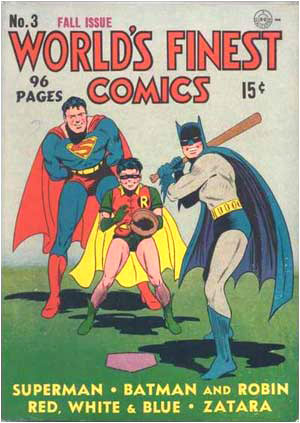
The third step in the re-working of Superman for the post-Crisis world is to establish his relationship with the one other hero in the DCU with the iconic power of Superman - the Batman. It's not exactly the logical choice, certainly not when key elements such as Lex Luthor, kryptonite, and Superman's regular villains have yet to make anything other than cameo appearances. And yet, it's an important choice, and certainly the right one. For many years (1941-1986), Superman and Batman had shared a title called World's Finest Comics. Although it took them thirteen years and seventy-one issues to actually star in a team-up, once they had done so, they would continue to do so for almost every issue up to its cancellation at the start of 1986. For a large portion of that run, Superman and Batman were the best of friends, happy with each other's company, and perfectly fine with meeting up regularly to defeat dastardly villains. In fact, whenever I think of the pre-Crisis Superman and Batman relationship, it's illustrated with the cover to World's Finest Comics #3, with big smiley happy-faced heroes.

In 1986, a Frank Miller comic called The Dark Knight (now more commonly known as The Dark Knight Returns) was released. Featuring an aged Bruce Wayne returning to the role of Batman after a twenty year absence, the series was a big hit, and was one of the titles that heralded the Modern Age of comics. The final issue of this series featured a knock-down, no holds barred one-on-one battle to the (almost) death between Batman and Superman (with a little assistance from Green Arrow). Although later issues of World's Finest would introduce a less-cosy relationship between Superman and Batman, this was pretty much the first time they really went for each other, fighting not just for the sake of fighting but for their different (albeit future) ideologies.

Here, Byrne strikes a bit of a balance between the two extremes. Whilst not full of loathing for each other, Superman takes issue with Batman's methods and his position of being above (or at least outside) the law. The issue resists the temptation to wrap up their relationship nicely at the end; whilst Superman accepts that Gotham requires a different type of super-hero to Metropolis, he is concerned that Batman could 'spoil it for the rest of us' and promises to keep an eye on him. From Batman's viewpoint, he does not like being told what to do by a super-human, and is concerned that Superman could (and indeed attempts to) apprehend him without giving him a chance to defend his position. By creating the bomb scenario and actually presenting himself as more villainous than he actually is, he puts himself in a position where he can prove his skills without being handed directly over to the police. Perhaps the biggest turning point in how Superman views Batman is in the moment where Superman expresses pity towards Magpie, and Batman reveals his human side by showing his sorrow for her victims.

Magpie is a bit of a non-starter as far a a villain is concerned. On the one-hand, she's a Joker-styla madwoman, giving dynamite cigars to paralysed henchmen and setting complex, lethal traps to cover her jewel heists. On the other hand she's a fragile, mentally confused compulsive thief. The two sides are hard to reconcile, especially as it's never quite explained how a shy, retiring museum curator gained the technical expertise to synthesise an acidic cloud or create chess pieces that fire miniature razor blades. It's telling that the character is barely revisited in either the Superman or Batman titles until she is murdered at the start of One Year Later. However, by pitting Superman and Batman against a 'low-rent' villain, someone who isn't one of Batman's regular nemeses, the story is forced to focus more on the interaction between the two heroes, and makes Superman's experience in Gotham less black and white.

The Geeky Bits: The first post-Crisis appearance of Batman. Well, sorta... it's the first in the context of Superman, but Batman never experieced a definitive 'Post Crisis Begins Here' moment that Superman and Wonder Woman did.

Magpie's non-exploding-head henchmen are designed to look like Mark Gruenwald (the one with the Hawaiian shirt and sunglasses) and Mike Carlin (the one with the beard who cries 'Not "Happy Birthday!"').

Next on World of Superman: The first of many re-tellings of the first meeting between Batman and Superman.

Tuesday, 13 April 2010

The Man of Steel #2

The Story Of The Century


Writer/Penciller: John Byrne
Inker: Dick Giordano
Letterer: John Costanza
Colorist: Tom Ziuko
Editor: Andrew Helfer
Cover: John Byrne
Cover Date: October 1986
Release Date: 24/07/1986

As Lois Lane and Perry White have coffee, Superman flies past the window. Since saving the space-plane, he has acquired a costume, and this is the first time he has been seen in public since the save. Perry sends Lois after Superman; this is her next big story. As Lois heads across the street, a limousine pulls up, and the driver tells her that Mr Luthor will see her. Even though Lex is due to leave for South America that evening for over a year, Lois refuses to get in, and runs off to chase the story. Unfortunately, the distraction has meant that she has lost her quarry. Undeterred, she calls her friend Chuck and calls in a favour.


Ten minutes later, and Lois is in the skies aboard a LexCorp chopper, looking for Superman. Chuck tells her that they won't be able to see him as he is more than likely flying close to ground level amongst the skyscrapers of Metropolis. Lois tunes into the police radio, eager for a tip-off.


Meanwhile, a punkish-looking girl with a large beatbox becomes the victim of a purse-snatch. The thief runs off, but runs into Superman. Turning around, he finds that Superman is now behind him. Realising that he has met his match, he surrenders the bag. Superman returns the bag to the owner, and deposits the thief into a garbage can for the police to collect. The boombox has details of a hostage situation in progress, and Superman flies off, pausing only to suggest that the girl turns her radio down.


The SWAT team and the hostage takers are in a stand-off. Despite not recognising Superman, the SWAT commander agrees to let him attempt to resolve the situation, pulling his men back at Superman's suggestion to avoid ricochets. Superman walks slowly and calmly towards one of the gunmen, pinching shut the barrel of his gun with no effort. The other crooks open fire, but the bullets bounce harmlessly off Superman's chest. Next, Superman uses his heat-vision to heat up the guns until they are too hot to hold. Finally, he renders the gunmen unconscious, and disarms the dynamite strapped to one of their chests. He makes a swift exit.

Lois has heard about the hostage situation, but has arrived too late. Chuck lets her jump off onto the roof, and she makes her way down to the street. She is miffed that she has missed Superman. Her efforts over the next few days yield no results, as she is constantly behind Superman, arriving only to see the aftermath of his presence. At the Daily Planet offices, she vents her frustrations at being unable to report on the very man she has named. A casual remark from Jimmy Olsen gives her the inspiration she needs to track down Superman...


As Superman patrols the city, he notices a sinking car, and recognises the occupant - Lois Lane. He flies down and rescues her car from the docks, just before she runs out of air, and returns her to her apartment. Stunned by what has happened, Lois is about to let Superman go when she comes to her senses, yelling at him to come back. Later on, having dried up and got changed, Lois interviews Superman. He playfully resists her questions, but agrees that the name 'Superman' is a good fit. As she presses for more details, Superman decides that it is time to leave. Just before he exits through the window, he asks her if she always carries an aqualung with her. She realises that he knew all about her plan and was just playing along. Superman flies to the roof of the Daily Planet, musing over Lois' ingenuity, and wondering if he could have noticed the aqualung before rescuing her. He changes to Clark Kent, and goes to meet his appointment with Perry White.


Two hours later, Lois rushes into the Daily Planet newsroom, clutching her exclusive write-up on Superman. The wind is completely taken out of her sails when Perry shows her the latest edition, which already has the story. He then introduces her to the author, the newest Daily Planet reporter - Clark Kent!

Good gravy, I love this issue!

This is quite possibly the first Superman story I ever read. I didn't realise this until long after I had become an avid Superman fan. At my primary school, the library had a treasury of all different kinds of comics in one hardcover. Everything from newspaper cartoon strips, to excerpts from Tintin. There were also American comic-books, including an Incredible Hulk story and, as I found out years later, this issue of The Man of Steel. I would have read this at about the same time that the Lois and Clark series made its way to the UK, maybe slightly before, and the similarities between the Superman I had read in the comics and the Superman I was seeing on TV pretty much set me up to be a fan of this incarnation of Superman. Years later, when I finally resolved to track down The Man of Steel and read it, I was hit by a strange sense of familiarity, especially with the scene involving the hostage takers, and I realised that long before I had heard of the 1986 reboot, I had read a key part of it.
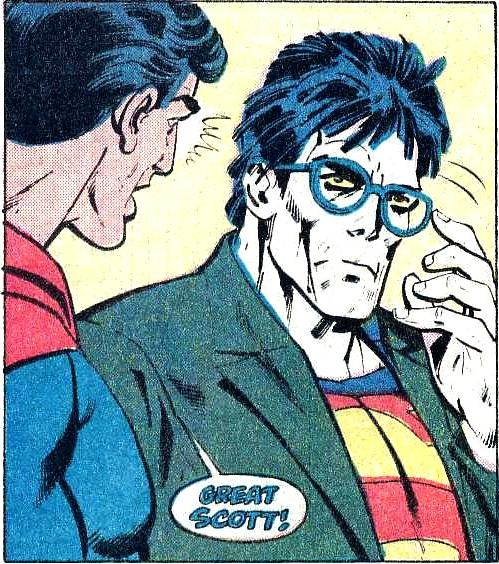
This is the Lois Lane issue. I don't think any other issue brings her to the heights of character that she hits here. A large part of that is that this is one of a handful of issues that deals with Lois as a reporter in her own right, not as Superman's girlfriend/fiance/wife. At this point, the only connection Lois has with Superman is that she gave him a name. She isn't a closely connected, both in private and in the eyes of the public, with Superman as she would later become, and it's great to see her in her element without her association with Superman.


The displays of Superman's powers and abilities in this issue are just great. The sequence with the mugger running into Superman in two different directions is strengthened by Byrne's decision to not show Superman's face until the mugger gives up; until then, all we see is what the mugger sees - a huge wall-like chest.

More exciting is the sequence with the hostage takers. Superman is clearly in control, not afraid to use a criminal's fear of him to his own ends. It is Superman's confidence that allows him to walk directly up to the gunman with the hostage and disarm him at close range. It is unlikely that Superman would have been able to use this tactic later on in his career, when his appearance is something to be anticipated, rather than an extraordinary occurence.

One of the best things that this issue does is to introduce Clark Kent to Lois Lane, not as a friend or a colleague, but as a rival. Clark's arrival at the Daily Planet is a massive snub to Lois, who finds herself in competition for her position as the top reporter, for her story, and for Perry's favour. Clark and Lois do not have a friendly relationship over the next few years, and this antagonism stems from the end of this issue. It takes Lois many years to get over losing the scoop, and the ups and downs of their relationship is a key point of the first years of the post-Crisis reboot. Most importantly, however, is that Clark is presented here as a strong reporter in his own right, not as a meek, shrinking violet-type figure that he was sometimes portrayed as pre-Crisis. This Clark is not to be messed with or ignored. and over the next few years of story, we'll see his role as reporter define him just as much as his super-hero adventures do.

The Man of Steel #1 & #2 have been re-printed several times over the years. The most recent printing of the series was in Superman: The Man of Steel vol. 1

The From Crisis to Crisis episode that deals with the first two issues of The Man of Steel is also their very first episode, and can be found here.

Next on World of Superman: If this is the first costumed appearance of Superman, then this must be considered to be Superman's Year One. Now, if only there were a series of annuals that had Year One as their theme... oh wait - there is! First up, The Adventure of Superman Annual #7.